


- Home
- Companies
- Pentair Filtration Solutions, LLC
- Products
- PENTAIR LiquiSep - Liquid Separation ...
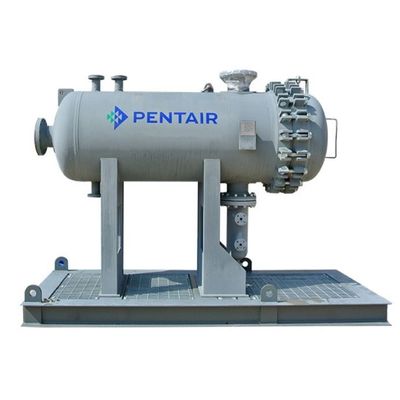
PENTAIR LiquiSep - Liquid Separation Technology
LiquiSep technology has been implemented specifically to help separate emulsions that are not separable by conventional coalescers. Conventional coalescers are unable to provide the degree of clarity associated with LiquiSep technology due to the inability to capture and remove the most penetrating droplets that cause carry-over. LiquiSep can separate these dispersed and emulsified droplets from the hydrocarbon to practically non-detectable levels. Advances in the technology now permit horizontal installations, further reducing capital cost. The effluent from a typical LiquiSep separation consists of two separate phases: one phase is a clear product hydrocarbon stream, and the second phase is a clear product aqueous stream.
- Advanced emulsion separation
- Cost efficiency high-quality output
- Scalability and modularity
- Operation flexibility
- Environmental and economic benefits
The Apex element is specifically intended to keep annular velocities constant across the entire height of the element. This is accomplished by introducing a gentle taper in the element, so that the annular space on the outside of the element gradually increases from the bottom to top, keeping pace with the external fluid flow as it exits the element.
The high fluid velocities at the circumference of the cylindrical element require the cylindrical elements to be spaced further apart. Apex elements do not have to be spaced as far apart, allowing the same flows to be handled in a smaller vessel, implying lower capital costs.
Addressing Aqueous Contamination
Hydrocarbon systems frequently encounter aqueous contamination. The aqueous component typically exceeds the soluble limit and accumulates within the hydrocarbon as a separate dispersed and emulsified phase. This stable emulsion is typically observed as a stable haze.
Challenges with Conventional Separation Mechanisms
The challenge associated with conventional separation mechanisms is that they depend on capturing the droplets through impaction of the droplet on a separation medium (such as wire mesh or filter media). As the droplets become smaller, the boundary layers around such media increase in dimension to the point that the droplets are much more likely to move around the fiber rather than collide into it. The capture of such fine droplets, then, requires advances in technology to reduce such boundary layers, as well as create additional mechanisms for droplet capture.