


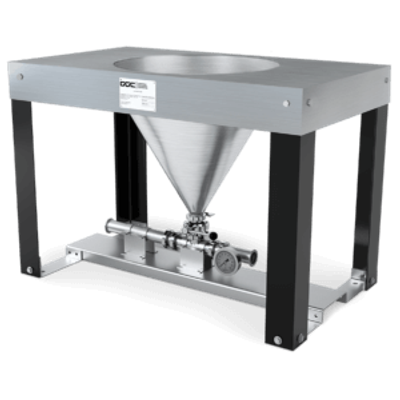
CCC - Model AZ -Mixing Eductor for Hydration and Dispersion
The AZ Mixing Eductor is engineered to provide efficient mixing, hydration, and dispersion by leveraging a conventional centrifugal pump or rotary gear pump. Unlike traditional systems that rely on mechanical shear, the AZ Eductor employs a non-circular nozzle to generate twin opposing vortices. These vortices interact to enhance fluid stretching and folding, which in turn increases interfacial contact and promotes rapid hydration. The process ensures uniform dispersion of slurry and improves slurry stability. This eductor is suitable for a wide range of applications, offering improved quality and cost reductions. It's available in multiple sizes ranging from 1 inch to 6 inches, allowing for versatility in different operational contexts. The product is patented under Patent No. 8,622,715, reflecting its unique design and functionality.
The AZ Mixing Eductor can provide the required energy to accomplish proper mixing, hydration and dispersion utilizing a conventional centrifugal pump or rotary gear pump. The AZ Eductor does not use mechanical shear to achieve uniform hydration and dispersion.
AZ Mixing Eductor Features:
- No moving parts
- Easy to disassemble and clean
- CIP capability
- Compact
- Light weight
- Stainless Steel construction
AZ Mixing Eductor Benefits:
- Rapid dispersion, hydration and particle solubility
- High-speed dosing rate
- Prevents lumps, “fish-eyes,” and microgels
- Uniform blend with polymers, starches, emulsions, clays, pigments, gums, and hydrocolloids.
The AZ Mixing Eductor has a non-circular nozzle that generates twin geometrically and opposing downstream vortices. The twin vortices interact with each other’s overlapping axes. The overlapping axes influence fluid stretching and folding. During the stretching, interfacial contact exposes individual strands that promote rapid hydration and the folding motion uniformly disperses the slurry. The dynamic interfacial contact in mixing will enhance the stability of the slurry.