

- Home
- Companies
- Advanced Micro Instruments, Inc. (AMI)
- Products
- Model LRP W/ Demister - Sample ...
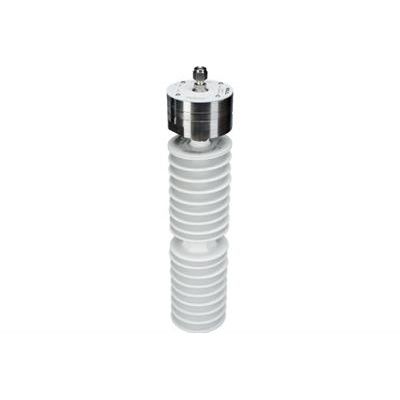
Model LRP W/ Demister -Sample Conditioning for Natural Gas Stream
Sample conditioning a natural gas stream for an analyzer can be a really tough problem. Natural gas frequently contains a lot of water, compressor oils, glycols, hydrogen sulfide as well as the gas itself. Just after a compressor or just out of a well the pressure can be high, but equally the pressure could be low or even below atmospheric pressure, particularly if the source shuts down while a downstream compressor is still operating. Just after a compressor the temperature can be over 150F, but the ambient temperature can be well below freezing. Puddles of water can collect at low points and when they come through, possibly driven by a “pig”, a sudden slug of whatever is it in it can come through, with no gas content at all.
- Effective particulate and coalescing filter
- Stops liquids from entering the analyzer
- Prevents vacuums from sucking air into the pipeline or analyzer
- No manual drain required
- No bypass flow which means no lost gas
- Regulator available for high pressure applications
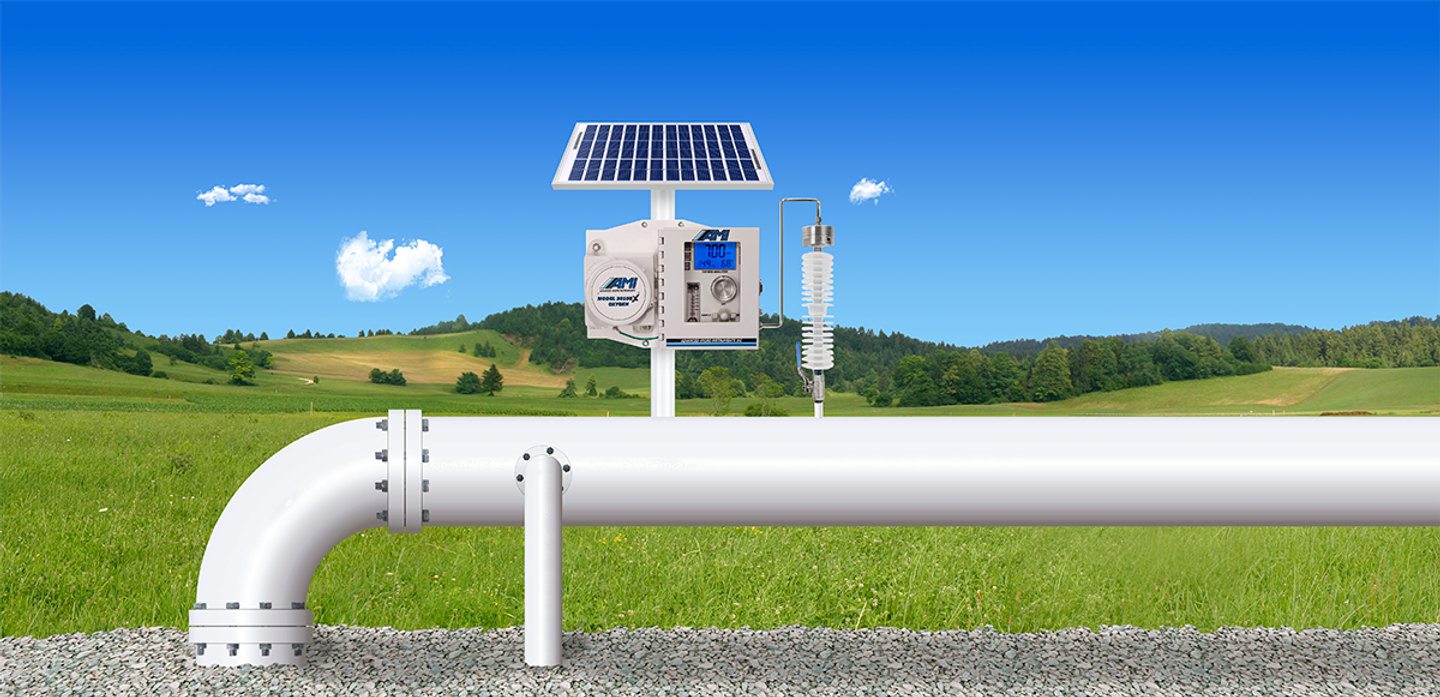
The combination of the LRP with the “demister II” is designed to deal with these issues. When the LRP is mounted on the demister, gases are cooled virtually to ambient in the demister, and condensate is allowed to flow back into the pipeline. Slugs of water are absorbed by the demister, and should they reach the LRP, its membrane filter will flex and seal off the sample flow before any liquid can reach the analyzer. When the liquid slug has passed, liquids once again can drain back into the pipeline and the LRP will resume gas flow. Condensate mist is caught by the membrane in the LRP and again returned to the pipeline. In this way, no bypass is required and no gas is wasted.
The demister does not extend into the pipeline and so will not interfere with – or be broken off by – the pig. If an upstream compressor goes down, but the downstream compressor doesn’t, the latter will suck a vacuum on the pipeline. If this happens, the LRP contains a very sensitive check valve so that no air is sucked into the analyzer via its vent and thus into the pipeline. As well as being a hazard in the line, the air would destroy the oxygen sensor in the analyzer. The LRP check valve prevents this.
For high pressure applications (above about 150psig) a version of the LRP is available with a regulator built in. This can handle pressures up to 1500psig.
- Maximum pressure - 125 psig with no regulator
- Maximum pressure - 1500 psig with regulator
- Dimensions - 3” dia x 2” tall
- Inlet port - ½” FPT
- Output port(s) - ¼” compression fitting.
- Maximum flow rate - 5 SCFH