


- Home
- Companies
- NGK Spark Plug Europe Gmbh
- Products
- NGK - Model MAP/MAF - Sensors
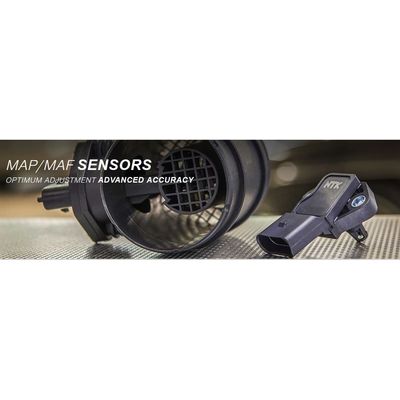
NGK - Model MAP/MAF -Sensors
MAP and MAF sensors have become an integral part of the engine management system. Their task is to send information to the vehicle’s Engine Control Unit (ECU), enabling it to control the air-fuel mixture needed by the engine to operate efficiently. NTK MAP and MAF sensors undergo rigorous tests to ensure they meet or even exceed the highest standards.
MAP/MAF Sensor Types
The majority of MAF sensors come in two variations: hot-wire technology and hot-film technology. These MAF sensors have no moving parts and use electrical current to measure air mass.
MAP sensors can be classified in two groups: manifold pressure type and boost pressure type. They provide immediate data on the manifold/boost pressure to the ECU, measuring air pressure to make calculations for fuel, and ignition calibration, which is vital to maintain engine efficiency.
MAP/MAF Sensor Function PrinciplesSituated between the intake manifold and the air filter, the MAF sensor is a vital part of the engine management system and determines the amount of air flowing into the intake system of diesel and petrol combustion engines. Based on the air mass information, the engine control unit is able to balance and deliver the correct fuel quantity to the engine. In diesel engines, the MAF sensor serves mainly to control the exhaust gas recirculation (EGR).
The MAP sensor measures the air pressure by the deformation of a membrane with integrated resistors. The pressure varies depending on the throttle position, engine speed and turbo operation. The Boost Pressure Sensor, in turn, is used in turbocharged engines and located between the turbocharger and intake manifold.