


- Home
- Companies
- Construction Battery Equipment (CBE) ...
- Products
- CBE - Oxide Ball Mill & Filter
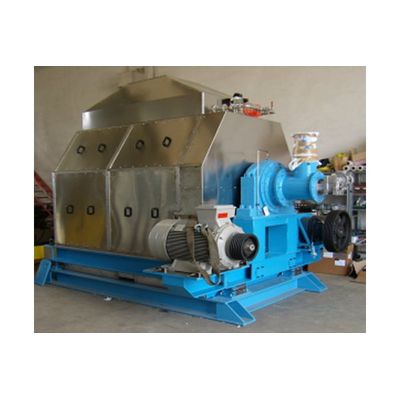
CBE - Oxide Ball Mill & Filter
The Ball Mill is suitable to produce lead oxide by means of friction between the cylinders produced before by the cylinder casting machine (Shimadzu method). Six parts compose it: Rotating room. It is made of steel, welded on the generatrix and mechanically worked, in order to enable the assembling using hubs, on which the ball bearings are assembled. Base and supports. The rotating room is supported by an electrically welded structural steel.
The barrel roller bearings that enable the rotation of the drum are contained in the cast iron housing. The base also supports the cooling water collection tank and the collecting hood, both made of stainless steel AISI 304. The base leans on the counterframe by means of three constrains and two load cells.
Transmission group. The rotation of the room is done by means of a reduction gear group, which transmits the motion to the pinion and crown, which is connected to the rotating room.
Lubrication system. The bearing lubricating system, which supports the rotating room, the main motor and the pinion, is centralised. The pinion and crown lubrication system is done automatically by means of a specific pump, which greases the kinematics motion following the time set in the PLC of the machine.
Cooling system. The temperature inside the Mill is adjusted by means of an efficient Outside water cooling system, and by an air flow, sucked by a fan positioned on the hood that laps the walls room. The temperature adjustment is assured by a thermocouple, which gives the temperature value, and by means of the PLC, which starts the cooling system if necessary.
Protection hood in stainless steel AISI 304 assures a suitable protection to the moving parts and enables to collect the cooling water sprayed on the outside part.
The necessary lead cylinder quantity is loaded from the cylinder silo into the rotating room. The rotating rooms starts, and after that, the fan at the base of the filter starts. The friction created by the turning cylinders makes little lead particles because of the temperature created inside, which oxidises and forms the lead oxide. The depression created by the fan installed at the base of the filter generates an air flux, which transports the lighter lead oxide grains from the mill to the filter.
The oxidation parameters are adjusted by means of a main PLC, which enable the supervision of both the working and the set parameters. The Mill in optimal working conditions (efficient filter, depression, speed rotation, inside temperature, etc.) enables to obtain up to 16-18 tons of lead oxide each 24-h, or 24-26T in 24-h.
The PLC controlled Ball Mill, thanks to recipes (set parameters), allows to maintain the correct cylinders feeding, a low consumption (cooling) of water, and air suction. This allows to work during the year in different environment and material conditions, allowing to produce optimum oxide.
- Feeding control of lead cylinders to have correct quantity/recipe/quality
- Continuous control of oxide production
- Best aspiration system that grants the right dimension of oxide aspiration
- Oxide does not need screening, only smaller particles pass to filtering and grant a top quality paste.
- Number of working parameters that grant complete set of recipes
- Cooling system outside the drum, keeping temperature on starting
- Alarms and signals in relation to exceed parameters
- Less water usage and low electricity consumption
- Lowest level of humidity of lead oxide
- Highest oxidation stability (less +-1%/24h)
PbO quality : Oxidation : 72 % 75% Acid suction > 230¸280 gr. H2SO4/cm3 PbO
Scott Density = 1.15 120 gr/cm3 BET 2,2 m2/gr