


PCH Engineering A/S
- Home
- Companies
- PCH Engineering A/S
- Products
- PCH - Model 1420 - 4-Channel Vibration ...
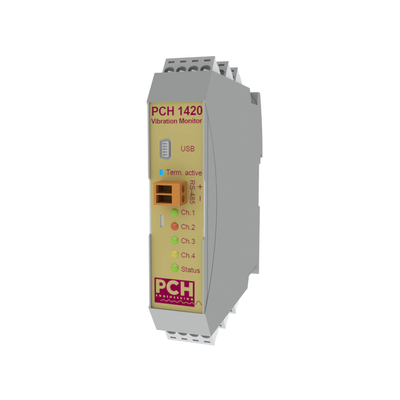
PCH - Model 1420 -4-Channel Vibration Monitor
The 4-channel PCH 1420 is an advanced vibration monitor which provides a wide range of real-time vibration data, remote data access and local alarms. You can use the PCH 1420 vibration monitor as a stand-alone solution or connect it to your SCADA or PLC system.
Most popular related searches
vibration monitoring
vibration data
vibration software
SCADA system
IoT system
optical bandpass filter
industrial centrifuge
axial fan
centrifugal pumping
spray dryer
- 6 input channels
- 4 configurable outputs
- Redundant safety relay
- Bearing fault detectors (Envelope, Crest, Kurtosis)
- Advanced local alarms
- Offline FFT analysis
- Cloud data for remote analysis (IoT)
- Part of the PCH Link Concept
IoT-enabled condition monitoring solution
PCH 1420 is compatible with our IoT solution, PCH Cloud. Data from the monitor can be stored in the cloud for remote analysis, making the PCH 1420 a valuable addition to your condition monitoring solution and Industry 4.0 environment.
- 4 vibration input channels (can also be configured for speed or temperature sensors)
- 1 process input channel
- 1 tacho input channel PNP/NPN/AC, optional 2-wire Namur or negative proximity probe
- 4 configurable outputs: relay, 0/4-20 mA, or 0/2-10 V
- Redundant SIL 2 safety relay
- User defined bandpass filters from 0.7 Hz up to 11,500 Hz
- Bearing fault detectors: Envelope, Crest and Kurtosis
- Adjustable alarm levels and delay times
- Time waveform recordings of vibration sequences from four channels simultaneously
- Offline FFT analysis
- Connection to several accessory boxes on bus system
- USB/RS 485 serial connection
- ModBus TCP via the PCH EtherBridge; Profinet is optional
The PCH 1420 is an advanced 4-channel monitor suitable for monitoring vibrations in traditional industrial environments as well as Industry 4.0 environments.
It can be used to monitor vibrations of critical assets such as:
It can be used to monitor vibrations of critical assets such as:
- Decanter centrifuges
- Separators
- Purifiers
- Gearboxes
- Blowers
- Industrial centrifugal and axial fans
- Centrifugal pumps
- Compressors
- Spray driers and atomizers
- Cooling towers
- Vibration sifters
- Turbochargers
- Wind turbines
The PCH 1420 vibration monitor gives you thorough insights into the condition of your machinery, helping you prevent serious machine damage and costly production stops.
This vibration monitor is the sensible choice when you wish to combine machine protection with the condition monitoring of roller bearings.
The PCH 1420 is a volatile 4-channel vibration and process system for the permanent monitoring of vibrations and process parameters in rotating machinery.
This vibration monitor is the sensible choice when you wish to combine machine protection with the condition monitoring of roller bearings.
The PCH 1420 is a volatile 4-channel vibration and process system for the permanent monitoring of vibrations and process parameters in rotating machinery.
Integration to existing condition monitoring systems
Easily integrate the monitor with your DCS, SCADA system or PLC through hardwired 4-20 mA signals, alarm relays or various interfaces like Modbus TCP/RTU, ProfiNet, OPC UA or IIoT (REST).
Remote data access with IoT-functionality
The PCH 1420 4-channel monitor offers a broad range of data, making it a valuable addition to your IIoT / Industry 4.0 environment.
Combine it with the PCH EtherBridge communication module and get online access to all your real-time vibration data in the cloud.
Combine it with the PCH EtherBridge communication module and get online access to all your real-time vibration data in the cloud.
Bearing fault detectors
The PCH 1420 offers both broadband high frequency monitoring, Envelope, Kurtosis and Crest factor for bearing fault detection.
All the detectors run simultaneously and are based on inputs from up to 4 measuring points in real time. Each bearing fault detector can measure the various fault indicators throughout the lifetime of the bearing.
All the detectors run simultaneously and are based on inputs from up to 4 measuring points in real time. Each bearing fault detector can measure the various fault indicators throughout the lifetime of the bearing.
4 input channels, 2 process channel and 1 tacho input channel
The four input channels are factory configured and calibrated prior to delivery. Gain factors are automatically configured with no user action required.
The vibration monitor has one embedded process channel and one tacho input channel. The process and Tacho channels are updated simultaneously with the four vibration input channels.
The vibration monitor has one embedded process channel and one tacho input channel. The process and Tacho channels are updated simultaneously with the four vibration input channels.
5 embedded outputs for optimal safety
The vibration monitor has five embedded outputs. Measuring values and alarms can be directed to the four digital outputs.
The fifth output, a redundant mechanical failure relay, will open in the event of missing sensors, sensors being out of range, short-circuits or general monitor errors.
The fifth output, a redundant mechanical failure relay, will open in the event of missing sensors, sensors being out of range, short-circuits or general monitor errors.
Redundant relay for trip alarms
The monitor design features a redundant isolated system failure relay, which you can use for trip alarms from all measuring bands configured with individual trip alarms.
Self-test procedures
You can also activate a self-test procedure through a digital input or through user software for testing the monitor and the outputs. This ensures a highly reliable data output and reduces the test cycle duration.
Advanced alarm functionality
When an alarm limit is exceeded, integrated alarms alert the user through a connected rotor light, a beeper, a control system, or by directly shutting down the machine.
LED lights on the front of the monitor clearly show the status of the four measuring channels, while a status LED light indicates general errors or failure conditions.
In the event of vibration alarms, the affected channel will turn yellow to indicate the alert level or red to indicate the danger level.
In the event of a sensor error or an overload, the individual LED for the affected channel will flash red, and the status LED will turn permanently red as well. Alarms or input errors from the process inputs will turn the status LED red.
The alarm functions can also be configured as needed.
LED lights on the front of the monitor clearly show the status of the four measuring channels, while a status LED light indicates general errors or failure conditions.
In the event of vibration alarms, the affected channel will turn yellow to indicate the alert level or red to indicate the danger level.
In the event of a sensor error or an overload, the individual LED for the affected channel will flash red, and the status LED will turn permanently red as well. Alarms or input errors from the process inputs will turn the status LED red.
The alarm functions can also be configured as needed.
Complementary software interface for analysis and individual setup
You can use the monitor’s standard setup out of the box or easily adapt the setup to your specific requirements using the PCH Vibration Studio software, which comes complementary with the monitor.
We offer several versions and configurations to provide you with a suitable solution for your specific application.
The complementary PCH Vibration Studio software provides online trending, simultaneous recordings of four time waveform signals (raw data), and an FFT tool for diagnostics and analysis.
The software is user-friendly, and you can connect a USB cable or a permanent RS-485 wire for remote access.
You access the PCH 1420 easily through the embedded USB 2.0 connector on the front of the monitor. The monitor settings are imported to your computer, and you can alter them from here.
The PCH 1420 also offers an RS485 2-wire connection for long distances and can be daisy-chained into a network of monitors.
The RS485 connection is used for the PCH Vibration Studio software and for the optional PCH EtherBridge LAN/TCP module (remote access).
A switch on the front of the PCH 1420 activates an internal 120 Ohms resistor in order to terminate the RS485 network.
We offer several versions and configurations to provide you with a suitable solution for your specific application.
The complementary PCH Vibration Studio software provides online trending, simultaneous recordings of four time waveform signals (raw data), and an FFT tool for diagnostics and analysis.
The software is user-friendly, and you can connect a USB cable or a permanent RS-485 wire for remote access.
You access the PCH 1420 easily through the embedded USB 2.0 connector on the front of the monitor. The monitor settings are imported to your computer, and you can alter them from here.
The PCH 1420 also offers an RS485 2-wire connection for long distances and can be daisy-chained into a network of monitors.
The RS485 connection is used for the PCH Vibration Studio software and for the optional PCH EtherBridge LAN/TCP module (remote access).
A switch on the front of the PCH 1420 activates an internal 120 Ohms resistor in order to terminate the RS485 network.
Input channels
The PCH 1420 vibration monitor has four input channels. This means it can be delivered for various types of vibration sensors, including:
- IEPE Piezo or 3-wire API 678 accelerometer (negative voltage)
- API 670 proximity probes (negative voltage)
- True Velocity sensors (moving coil technology) ±10V
- PCH Low Frequency MEMS accelerometers
- DC signals like 4-20 mA or 0-2.4/5/10V for process
Speed sensor input
- Configurable speed measurements based on an NPN/PNP sensor or through an AC signal 0-30V (>10V)
- Number of pulses per rotation are user configurable, up to 5000 per second
- Full scale range RPM is user configurable
- Missing pulses can be detected and activate an alarm
- Can be delivered for a proximity probe (Keyphasor) signal as speed input.