- Home
- Companies
- 2B Technologies
- Products
- 2B-Technologies - Personal Air Monitor ...
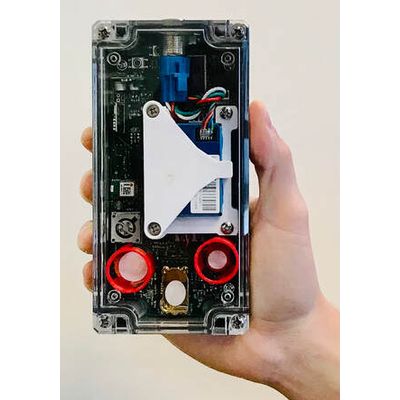
2B-Technologies - Personal Air Monitor (PAM)
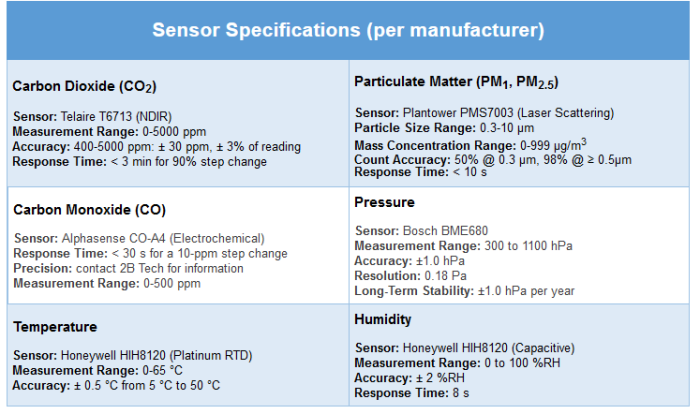
The Personal Air Monitor or PAM was originally developed for our AQTreks K-12 educational outreach program and is now used in a wide range of other applications such as monitoring of smoke by the National Forest Service during forest fires, vertical profiling of air pollutants using quadcopters and hyperlocal mapping of air pollutants along streets of cities. The PAM was designed to measure only the air pollutants for which sensors are highly reliable, which includes particulate matter (PM1, PM2.5), carbon monoxide (CO) and carbon dioxide (CO2).
The PAM also outputs values for PM10, but as discussed on our AQSensors vs. Instruments page, PM10 is not accurately measured by sensors because of the difficulty of sampling large particles without loss due to impaction. PM2.5 and PM1 are the most important size ranges, however, because only particles smaller than 2.5 µm enter the lungs where they have adverse health effects such as triggering asthma attacks. All three pollutants measured are products of combustion, making the PAM ideal for tracking air pollution arising from automobile exhaust, power plants, forest fires and other combustion sources. Carbon dioxide is of interest outdoors because it is the principal greenhouse gas responsible for global warming, but also indoors because CO2 builds up inside buildings due to human respiration and affects human cognitive abilities at concentrations above about 1,000 ppm.
Many companies sell sensor packages that measure additional air pollutants such as NO, NO2, SO2 and H2S using electrochemical sensors. None of these species are reliably measured by sensors without very frequent multivariate calibrations due to a combination of factors including 1) their very low ambient concentrations, 2) sensor calibration drift and 3) cross sensitivities. As new sensors become available that achieve adequate sensitivity and accuracy to be useful for air pollution monitoring, we will make them available on the PAM. Note that of the species measure by the PAM, PM2.5 and CO, are designated by the US Environmental Protection Agency as Criteria Pollutants.
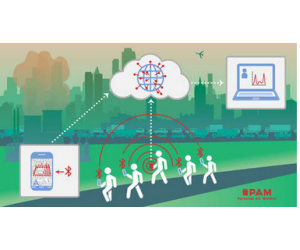
AQTreks is an K-12 educational outreach program sponsored by 2B Technologies. In AQTreks students learn about air pollution though a hands-on experience in which they make use of a PAM to measure air pollutants along treks of their own design. During a trek, one student carries the PAM, and data from the PAM are continuously broadcast via Bluetooth to the mobile phones of other trek participants. Students follow the concentrations of air pollutants in the AQTreks app on their mobile phones where data are displayed on a map and as a time series for each pollutant and meteorological variable. The app also shows the current 1-hour averages of air pollutants at the nearest state and local air pollution monitoring stations for comparison. At the end of the trek, students have the option of uploading their trek to the AQTreks database for public (or private) display on the web. The AQTreks program has an online curriculum on air pollution and is available to schools, museums, botanic gardens and other educational programs. As discussed in our 2019 Atmospheric Environment paper describing our GO3 Project and AQTreks outreach programs, more than 8,000 students at more than 150 schools across the U.S. have participated in AQTreks and it`s predecessor GO3 Treks. Please see the AQTreks website for more details.
- Measures CO, CO2, PM1, PM2.5, temperature, pressure and relative humidity
- Bluetooth data broadcast to nearby mobile phones (IOS and Android)
- AQTreks mobile app for real-time mapping and graphing of data
- 2G/3G/LTE real time cellular data transmission to the cloud
- Wifi connectivity addressable over the internet
- Internal GPS
- microSD data storage
- Rechargeable 3.7 V, 200 mAh battery with 6-hr to 8-hr life
- A NEMA stationary PAM enclosure is available for fixed base monitoring
- Can be used in combination with a Model 106 FEM ozone monitor in the Community Air Monitor (CAM) enclosure for continuous measurements at a fixed location
- Can be used in the 2B Technologies CarTopper for mobile monitoring via automobiles and other vehicles