


- Home
- Companies
- Cornell Scientific Instruments Pvt. ...
- Products
- PROMETHEUS PANTA - Protein Stability ...
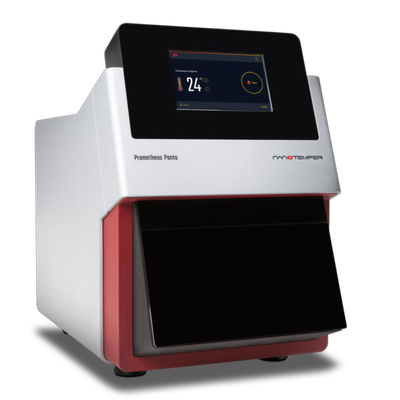
PROMETHEUS PANTA - Protein Stability Characterization Instrument
PROMETHEUS PANTA represents a comprehensive solution for protein stability characterization, offering multi-parameter data on conformational and colloidal stability. Designed to reveal liabilities or stability enhancements that other technologies might miss, this instrument allows for the measurement of thermal stability, aggregation, and particle sizing and dispersity within a single run, without the need for labels or large sample sizes. It provides reliable, high-resolution data useful in evaluating protein stability, making it optimal for challenging stability characterization tasks. Employing technologies such as nanoDSF, DLS, backreflection, and SLS, PROMETHEUS PANTA presents a diverse array of information pertaining to thermal unfolding, particle sizing, and aggregation. This unified approach in a single instrument facilitates a thorough understanding of stability, catering to a variety of applications without using labeled candidates.
With multi-parameter information on conformational and colloidal stability from Prometheus, you’ll see liabilities or stability enhancements that other technologies miss.
Only Prometheus enables you to measure thermal stability, aggregation, and particle sizing and dispersity in a single run-label free, and without using lots of sample. Unveil hidden stability behaviors and feel confident that you’re progressing with the best candidates and conditions. Get trustworthy, high-resolution data on your protein’s stability from Prometheus.
Tackle challenging stability characterizations with multiple technologies in one instrument
Prometheus uses a number of technologies to characterize thermal unfolding, particle sizing, and aggregation. Each one tells a different story about stability, and is used for a variety of applications. But they have one thing in common — they are all label-free candidates
nanoDSF , DLS, Backreflection and SLS in a single instrument.
- This is the ideal situation – no dyes are needed, neither is sample dilution or alternate buffer conditions. Running experiments with viscous samples is also not an issue.
- Samples are precious so using less to do more is always the goal. Requiring as little as 10 µL in volume and 5 µg/mL in concentration is always a plus.
- Wouldn't it be great to just quickly load samples and get a result in minutes? No sample prep needed, just load as-is.
- The flexibility to design experiments by testing multiple parameters in one run makes it easier to get to the end goal sooner.
- A high density of data points means better data quality and seeing details missed by other technologies.
- Decide to run 1, 48 or any number of samples in between and do only what's necessary. Or, choose to automate and do more.