


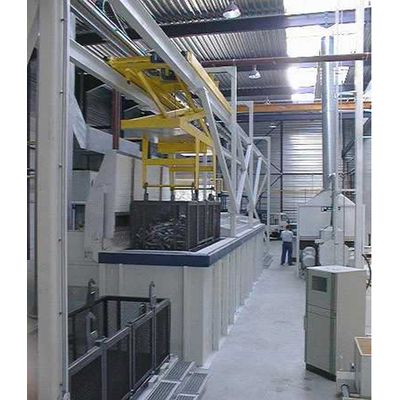
SCALA Technology
Our ‘scala’ technology has originally been developed in close collaboration with research institutions and industries specialized in green sand aluminum casting technology and rapid prototyping. It has been developed with the intent to play a role in improving the durability of castings and reducing the ecological impact compared to more traditional treatment methods with mechanical shaking stages for de-coring and mould sand removal and huge furnaces and quench tanks for turning a green sand casting from the fresh casting into a finished part ready to be mounted in its final destination.
VV-net can design and supply a well balanced range of all integrated casting heat treatment solutions that can either be supplied as standardized products or can be modified in customized well fitting turn-key systems. We especially offer our expertise to develop validated processes for end users, equipment suppliers or associations, and so wish to contribute to a more ecological world by spreading these modern techniques.
With the powerful ‘BORA’ suspended particle reactors, a mild but still fast ‘soft quench’ can be provided. Bora systems work either with cooled reactor flow and / or a built-in evaporative cooling system to remove the heat from the quenched castings and keep the reactor at the desired temperature. Finally, our ‘ZEPHYR’ preheated suspended particle reactors can add a fast and ultra precise ageing stage to the all integrated heat treatment process whenever this is required.
The castings to be treated are stacked in a carrier, which is subsequently submerged into the bubbling reactors, one after the other, like in a liquid, each at their respective temperature for solution heating and sand removal, for quench-cooling or for ageing, all depending on the exact alloy and the validated treatment requirements. Solutions where castings are processed individually or in smaller batches directly as they come from the foundry process can be worked out and fully automated, further reducing labour and energy consumption.
- Engine blocks, cylinder heads, pump rotors, turbines and their housings
- Castings with complex internal structure and thin walls or fins and material saving supports and fixtures
- Limited series and rapid prototyping applications
- Applications where shaking methods for mould and core sand removal could damage the castings.
- Series where short cycles are desirable to optimize quality validation throughout the production process.
- Large production series where advantageous treatment cycles have been thoroughly optimized and validated in collaboration with customers or foundries, including automated individual parts processing.
- Applications where space limitations are critical and all integrated compact solutions are needed.
- Processes where use of raw material and natural resources is a dominant criterion in a more sustainable world.
Our mild and soft ‘scala’ thermal all suspended particle reactor heat treatment systems have distinct advantages with respect to accuracy, resulting in high energy savings, short cycle times, soft de-coring and mould sand removal, and parts which are genuinely stronger in their environment of application. They offer reduced ecological impact and use of natural resources in a simple and reliable concept : more economic, more friendly for the parts, with less labor and better for the environment.