


- Home
- Companies
- FLSmidth A/S
- Products
- KREBS® - Model gMAX® - Special ...
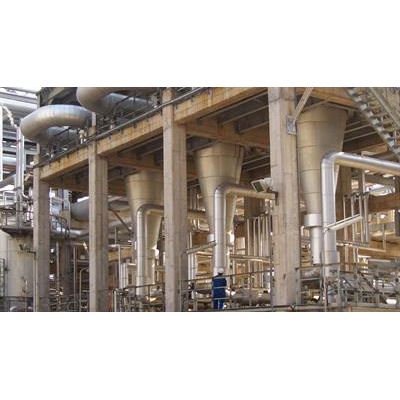
KREBS® - Model gMAX® -Special Industrial Cyclones
The terms ‘separator’ and ‘hydrocyclone’ describe the same general type of solids/liquid separation devices. So, what is the difference?
A hydrocyclone, also known as a ‘cyclone,’ is a centrifugal device with no moving parts. It can be used to concentrate slurries, classify solids in liquid suspensions, de-grit liquids and wash solids.
Cyclones are frequently used as protection or pre-treatment devices to improve the performance or decrease the cost of downstream equipment, such as centrifuges, filters and screens. Cyclones are also used in conjunction with thickeners, clarifiers and strainers.
A separator, on the other hand, is used primarily in a closed system that is under high pressure, where the solids loading is low, or in applications where very fine separations are not required but liquid loss must be minimised. A separator is often referred to as a ‘desander.’
Cyclones can perform ultrafine separations and handle large volume feed streams with high solids loading. The cyclone has an open apex permitting continuous underflow discharge. In contrast, a separator has a closed apex. The underflow discharges into a closed grit chamber, which is periodically emptied by automatic or manual means. Otherwise, their separating action is the same.
High-performance cyclones with low capital cost, long wear life
Finer, sharper separation at high capacities
The cyclone inlet and cylindrical sections of our gMAX cyclones have been modified to minimise turbulence and wear, while still having the ability to operate at much higher capacities than our older generation of cyclones. A combination of more sharply angled upper cones, followed by longer, angled lower cones, maximises tangential velocity in the upper part of the cyclone while providing higher velocities in the lower section. This results in finer separations, with fewer fines in the underflow and less coarse particles to the overflow.
Custom designed for extreme conditions and materials
Our cyclones are designed to handle high temperatures and very high pressures for abrasive or corrosive slurries. More than 90% of the metal industrial cyclones we build are custom designs, specific to our customers’ applications. All cyclones can be modified to fit the customer’s requirements. We design our Special Industrial Cyclones to ASME Code, section VIII and Division I, when required by the application.
Accurate separation based on performance prediction
We have the capability to analyse and accurately predict the performance of the cyclones we design. What does that mean for you? We can predict how your cyclone will perform under harsh conditions, in extreme temperatures and under high pressures, or whether your cyclone will require specified throughput – all prior to customising the cyclone for your needs. Thus, we can provide the best design and material of construction for the best performance.
Low capital cost, money-saving benefits
With a low capital outlay, our Special Industrial Cyclones also provide the benefit of saving you money by removing grit and other abrasive solids from your process liquids – ultimately saving your expensive downstream equipment from potential harm.
Long life under harsh conditions
Our Special Industrial Cyclones are designed to operate in corrosive applications or under harsh slurry conditions. With no moving parts or liners, our cyclones’ wear life exceeds that of our competitors’ cyclones.
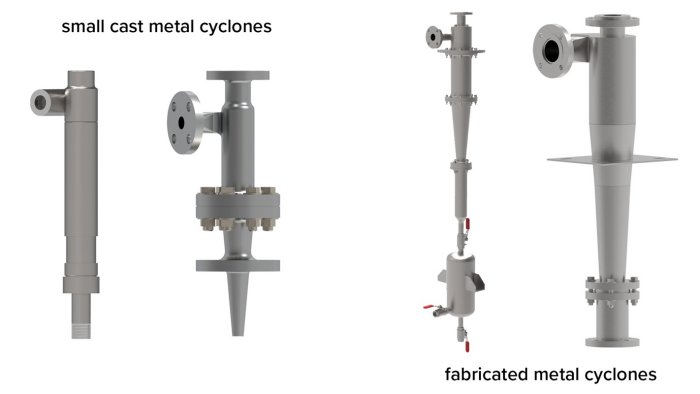
We have illustrated below a few of our cast-metal and fabricated-metal Special Industrial Cyclones, along their typical applications.
Sizes: Cyclone diameters range from 0.5" to 2". Standard connections are threaded but flanged connections can also be supplied.
Materials: Standard material of construction is 316L SS; can be cast in other alloys upon request.
Applications: Used for fine solids removal in chemical and other industrial applications, such as pump seal water, degritting, and protecting analysers.
Sizes: Cyclone 2" diameter.
Materials: Standard material of construction is 316L SS, can be cast in other alloys upon request.
Applications: Used for fine solids removal in chemical and other industrial applications such as, pump seal water, degritting, and protecting analysers.
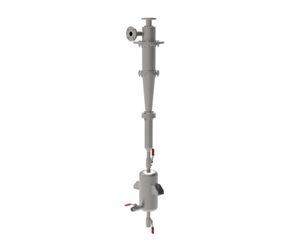
Sizes: gMAX metal cyclone diameters range in sizes 4" to 26".
Materials: Fabricated from any metal; some units can be designed to accept replaceable ceramic liners. Can be built to ASME code specifications, if required. The accumulator tank on the bottom accumulates the solids for periodic discharges.
Applications: Used in processes that have very low solids concentrations in the feed and where minimising liquid loss is important. Can be used in food and beverage applications to remove grit from purees, grit from juice or wine, and separation of sand from cooked peppers in the production of hot sauce and other purees.
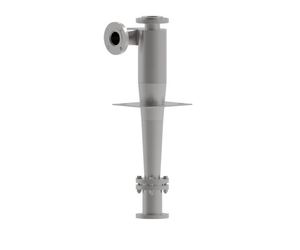
Sizes: Fabricated-metal cyclone diameters range from 4" to 90".
Materials: Fabricated from any metal; some units can be designed to accept replaceable ceramic liners.
Applications: Used in applications where corrosion could be an issue and solids loading is relatively high, requiring a constant underflow discharge. Main uses are on scrubber circuits and crystalliser circuits.
For more information, contact us. One of our experts will help you determine the best cyclone for your separation process
Automotive paint applications:
- Parts washing and cleaning process: Remove grit from cleaning fluid solvents
- Coolant degritting: Remove grit from coolant recycling process
Chemical applications:
-
Evaporators and Crystallizers: Recover and concentrate nucleated particles in evaporators and crystalliser circuits. By strategically placing the cyclones before centrifuges or other crystal dewatering equipment, they can substantially reduce the load on the downstream operations. The net result is more stable operation of the dewatering stage, as well as allowing for the use of smaller dewatering equipment
- Filtration: Remove solids ahead of filtration equipment. The primary purpose of the cyclones when used in this application is to remove the majority of solids and protect the filter from overloading. The result is reduced filter maintenance and extended filter life.
-
Analyzers: Remove solids ahead of the analyser by processing a side stream through the cyclone. The cyclone overflow reports to the analyser, while the underflow is discarded or sent back to the main process.
- Quench Oil: Remove coke particles from quench oil. Very large insulated cyclones are used to remove coke particles from quench oil to protect heat exchangers from plugging.
Food and beverage applications:
- Ketchup and Purees: Improve quality by cleaning pre-cooked pulp in a separator. Following pre-cooking and pulping, an ultra-high-efficiency stainless steel cyclone is used to clean the stream.
- Wine processing: Remove seeds, dirt and solids from the crushed grape juice.
- Jams, Hot Sauces and other Purees: Remove dirt and metal particles prior to the milling step, to protect the milling machine.
- Cooked seaweed: Remove sand and other grit.
- Potato starch recovery: Remove starch in cutting circuits, allowing the water to be reused and the starch recovered for additives in animal feed.
- Crumbs from cooking oils: Removal of grit and crumbs from oil which extends the life of the cooking oil
- Wash-down water in frying plants: Remove oil from wash-down water, reducing the COD demand on the waste water treatment and also reducing sewer fees.
Special Industrial Cyclones are ideal for these and many other applications and industries. For more information about our cast and fabricated industrial cyclones, contact us - one of our experts will partner with you to discuss your specific needs.