


- Home
- Companies
- Teledyne API
- Products
- TAPI - Model 651 - Ultrafine Particle ...
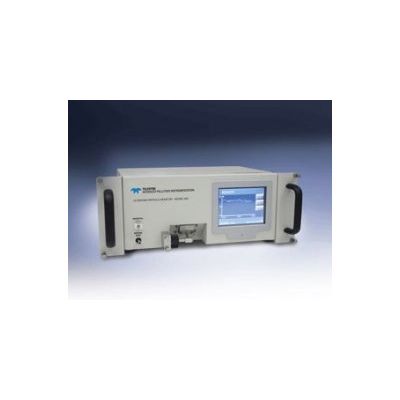
TAPI - Model 651 -Ultrafine Particle Monitor
Ultrafine particle (those less than 100nm, or 0.1µm in size) are produced through combustion activities and are persistent in all ambient air. Concentrations of these tiny particle can be very high near emissions sources (for example, near busy roads), and both acute and chronic exposure are believed to lead to health problems. As part of the new US EPA near-road ambient monitoring network, ultrafine particles (UFPs) will be monitored to determine concentration levels and further study health effects related to exposure.
The Model 651 Ultrafine Particle Monitor provides a simple and reliable solution for the real time monitoring of UFP concentrations in ambient air. The instrument uses a condensation particle counting technique, using water as the condensing fluid followed by laser detection. UFPs down to 7nm in size are detected, with time resolution down to 1-second. Sample collection, preparation, and analysis occur continuously, with a routine maintenance interval of 30 days.
The Teledyne API Model 651 Ultrafine Particle Monitor is an ideal solution for today`s routine ambient air quality monitoring applications.
- Real time, continuous ultrafine particle monitoring
- Water-based condensation with laser detection
- Standard 19 inch rack mountable chassis
- Long autonomy period - 30 day maintenance interval
- Automated health and status monitoring
- 7 nanometer detectable particle size
- Sampling interval down to 1-second
- Internal Data Storage
- Communications via USB, Ethernet, or RS232
- Remote monitoring, data retrieval, and control
- Principle of Analysis : Water-based condensation particle counter
- Range : 0.001 to 106 particles/cm3
- Particle Size Range (D50) Range : 0.007µm (7nm) to ~3 µm
- Particle Concentration Accuracy : +/-10% at 106 particles/cm3
- Measurement Averaging Time : 1 to 3600 seconds (1 hour)
- Response Time :
- <3 seconds to 95% in response to concentration step change (high flow mode: 3 lpm);
- <5 seconds to 95% in response to concentration step change (low flow mode: 0.6 lpm)
- Flow Rate :
- 0.6 +/- 0.06 lpm (low flow mode) ;
- 3.0 +/- 0.3 lpm (high flow mode)
- Environmental Conditions : 10 – 38ºC (50 – 100ºF) non-condensing; (Recommended: 20 – 25ºC)
- Power Requirements : 100-240 VAC, 50/60HZ, 145W max
- Analog Output Ranges : 0-4V proportional to log concentration
- User Interface : Color touchscreen display
- Communications : Ethernet, RS232 and USB
- Dimensions (HxWxD) : 8” x 19” x 12” (203 x 483 x 305 mm)
- Weight : 22 lbs (9.9kg)