- Home
- Companies
- Nanjing Tangent Fluid Technology Co. ...
- Products
- TFT - Model MF/UF CRM - Ceramic ...
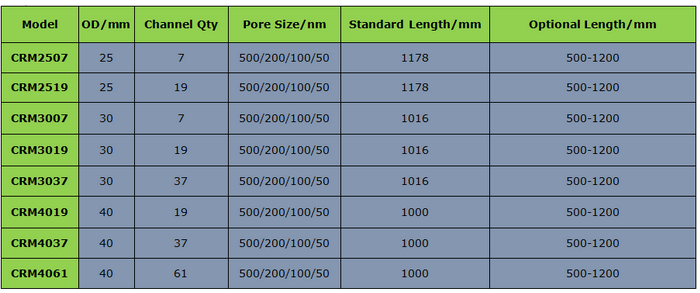
TFT - Model MF/UF CRM -Ceramic Membranes
Inorganic membrane is a kind of porous fine ceramic filter which is sintered from Alumina or Titania , Zirconia under ultra-high temperature. Inorganic ceramic membranes normally have an asymmetrical structure with porous support and active membrane layer. The macro porous support ensures the mechanical resistance while the active layer serves as functions of separation ranging from microfiltration, ultrafiltration and nanofiltration (from 10μm down to 1KD).Inorganic ceramic Membrane always runs in crossflow filtration (tangential flow filtration). The turbid fluid goes through inorganic membrane membrane layer inside the channel at a high velocity. Driven by Trans-Membrane Pressure(TMP), the clean liquid with micro-molecule passes through the membrane layer vertically to permeation, the solid and big molecule is rejected in retentate. The feed fluid is thus clarified,concentrated and purified.
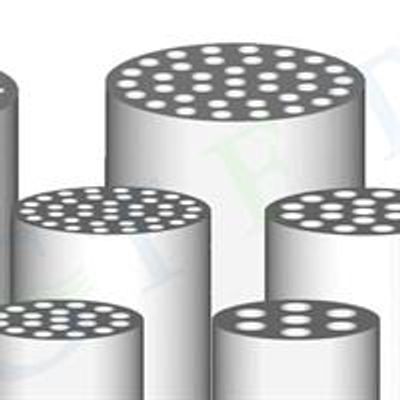
CRM inorganic ceramic membrane has an asymmetrical structure, consisting of three layers: membrane filtering layer, intermediate layer, and supporting layer. The pressure drop of such asymmetrical structure is lower than that of symmetrical structure, which means that the ceramic membrane has better recovery of daily performance. Inorganic ceramic membranes are tubular composite membranes on an open porous carrier tube made of high purity α-alumina oxide. All have 99.5% pure alumina as a supporting layer. The tube is optimized for maximum water permeability and high mechanical stability (bursting strength >100bar).CRM inorganic ceramic membrane has a micro pore membrane with alumina /zirconia oxide as a surface-active layer. This layer makes up the actual membrane layer. Depending on pore size of the membrane, one or more layers with decreasing pore size are applied and sintered. Therefore, CRM inorganic ceramic membranes can be used in membrane ultrafiltration, microfiltration and nanofiltration in cross flow filtration (tangent flow filtration).
- Fine separation accuracy with narrow pore size distribution
- Excellent resistance to strong acid, caustic, oxidation chemicals and organic solvent
- High thermal stability and steam disinfected
- High abrasive resistance and high strength, long work life
- High flux, backwash ability, high efficiency
- Easy operation with low maintenance cost and low labor cost
- Less waste disposal cost
- Less CPEX and OPEX
- Compact design with less footprint