


ATI - Model V Style Probe - SATI Series -Ultrasonic Anemometer
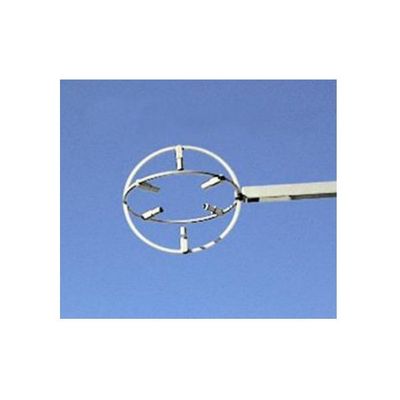
Applied Technologies, Inc. - Ultrasonic Anemometer - "V" Probe. The `V` style Ultrasonic Anemometer is a 3 axis, 3d, 10 cm, scientific Ultrasonic Anemometer that is a special design for turbulence, where eddy measurements must be the smallest, for flux measurements in plant and forest canopies where wind speeds are very low and directions are highly unpredictable. The electronics are contained within the probe bar. It operates on DC power with a power consumption of less than 100ma (depending on options). This meteorological instrument can be used in many different weather systems for highly accurate wind speed, wind direction and temperature information. These instruments have been established for use in Eddy Covariance work, which includes Turbulent Fluxes, Momentum Fluxes, Latent Heat Fluxes and Sensible Heat Fluxes. The new design incorporates leveling and vibration monitoring capabilities.
The Applied Technologies, Inc. (ATI) Sonic Anemometer/Thermometer is a microprocessor based wind sensor capable of measuring wind velocity in one, two, or three axes with reliable accuracy. The instrument is designed to measure wind velocity components by transmitting and receiving sonic signals along fixed orthogonal directions. The microcomputer electronics then process this information and calculates the wind speed for each axis. Since there are no moving parts to come into dynamic equilibrium with the air-flow, the Sonic Anemometer/Thermometer responds rapidly to wind velocity fluctuations. It responds linearly to wind velocity and is free from contamination from other velocity components as well as pressure, temperature, and relative humidity. The calibration of the sensor is established by its design parameters and therefore, can be used as an absolute wind instrument. That is correct, an Absolute Wind Instrument, with an accuracy that is controlled by the operator.
The electronics are all contained within the probe bar, and the transducers are completely sealed. This allows it to be operated as a tower mounted instrument, capable of withstanding hostile environmental conditions. The transducer operation and sonic functions, as well as all computation and transmission of data are under microprocessor control.
Data from the Sonic Anemometer/Thermometer are digital in nature. The output is RS-232C compatible in a UART asynchronous format. It represents the data in ASCII decimal numbers, and may be connected directly to a computer, transmitted to any digital recording device, or the format is such that it can also be read directly on a terminal. The temperature information is the sonic temperature of the measured winds and is calculated.
- Single component wind velocity
- Fast response wind velocity
- Fast response temperature
- Extreme accuracy
- Microprocessor based
- Solid-state digital operation
- No moving parts
- Unattended operation
- Ease of mounting
- Rugged construction
- Low power
- DC powered
- True orthogonal measurements
- 3D winds
- Ability to do remote commands through the serial port
- Perform internal calibration to maintain accuracy
- User programmable data rates and averaging, from 1 output per 60 minutes to 200 Hz
- Select data averaging or median filter
- Select from several output formats
- Select from several baud rates
- Synchronize sonic operation to external trigger
- Ability to output a trigger pulse for other instruments
- Select the output Speed of Sound and/or Temperature
- Enter RH value for more accurate temperature output
- User adjustments to temperature calculations
- Change horizontal velocity to wind speed & direction, while retaining vertical and temperature
- User adjustments to data quality calculations
- Ability to provide data quality status word in output format
- Turn flow distortion correction on or off
- User adjustments to flow distortion calculations
Measurement Range:
- Wind velocity: ±15 m/sec
- Temperature: -50 to +70?
- Wind Direction: 0 – 359 Degrees
Path Length:
- "V" Probe: 10 cm
Accuracy:
- Wind Speed: ±0.01 m/sec
- Orthogonality: ±0.1 degrees
- Temperature (absolute): 1.2?
- Sonic Temperature: ±0.1? or ±0.05°C
Resolution:
- Wind Speed:
- 0.01 m/sec (normal)
- 0.001 m/sec (optional)
- Wind Direction: 0.1 degrees
- Temperature: 0.01?
Output:
- Data Rate:
- Digital: Serial RS-232C compatible (RS-422 Optional)
- Baud Rate: 4800 or 460,800
- Speed of Sound: Operator Optional
- Operating Temperature Range: -50? to +70?
- Power Requirements: +12 VDC@ <100 mA, (9 – 32 VDC)
Probe Array:
- "V" - Three Axis: 17.8cm x 17.8cm x 17.8cm
- Weight: <1.0kg
- Mounting: 3.175 cm square tube
Is there a special option you would like for the Applied Technologies, Inc. Ultrasonic Anemometer? If you don`t find it listed here, let us know and we will see what we can do.
There are a variety of add-on options available for the ATI Ultrasonic Anemometers. Some of these options must be selected at the time of your order, consult the factory for more details.
2D & 1D Sonic Probes
Should you require the accuracy and speed of the SATI sonics, but don’t need the 3D version of the instrument, we can also provide a 2D and 1D version of the instrument. These will provide all the same features and functions as the 3D, but with the lesser axis or axes. If this is of interest, contact ATI for more information.
LV-304 Option - 2D Level / 3D Accelerometer
The LV-304 is a level/accelerometer that can be connected to the sonic anemometer. This system measures both dynamic and static acceleration. The static operation can measure gravity and therefore can be used as a level or tilt sensor. In this mode it can provide an output of ‘pitch’ and ‘roll’ for the position of the instrument. These data are read in degrees.
The dynamic operation can measure motion or shock and therefore can be use to monitor any movement of the instrument. In this mode it can provide an output of acceleration in the three orthogonal axes. These data are read in digits that represent gravity.
Data from the unit will be output as fast as whatever rate the instrument is set to measure.
RH-101 Option – Relative Humidity input to the sonic
Given that the temperature output of the sonic is dependent upon the Relative Humidity, the basic probes have a command that allows the operator to enter the RH value of the air being measured to improve the accuracy of output. This works, but is a bit cumbersome since the value needs to be changed as the RH changes.
The RH-101 is a special analog input that is added to the Sonic Anemometer and used to provide an RH value to the processing of the Temperature output. This input is used in the calculation of the output temperature to provide a more accurate temperature value in real time. The cost of this option does also include the RH sensor to be used with the sonic.
This option is currently designed for one specific RH sensor, the HMP60, but if another type of sensor might be of interest, check with the factory to see if this is possible.
RS-422 Option
Does your instrument require extra long cables to connect to your DataLogger? Or maybe an extra long cable that can reach all the way to your office? Our equipment can be provided with an RS-422 output for this purpose. If this is of interest, contact ATI for more information.
MT-104 Option – Mounting fixture
The ATI sonics are built on a horizontal square tube and are meant to be mounted horizontally. If you have a vertical tripod pole for which to mount your equipment, we have a special combination of U-bolts that will do the job. These will allow you to attach the horizontal square bar of the sonic to a vertical 2” diameter pole.
MT-608 Option -- Extension mounting arms
The ATI sonics are built on a horizontal tube and are meant to be mounted horizontally. If you are putting your ATI sonic anemometer on a tower, you may require a longer support arm to extend the instrument further out away from the tower. ATI has such extension arms for this purpose. They come in 6’ and 8’ sections, and if need be we can also combine them to reach longer distances. If this is of interest, contact ATI for more information for these items.
Extra or Spare Parts
Do you need different lengths of output cables? Maybe you would like to have a spare cable on hand for emergencies? Or would you like to have some spare parts like extra connectors available? Or would you like an extra or replacement mounting bar. If any of these options sound like something of interest, contact ATI for any questions.
Another possibility might be if you are planning to use your instrument in a very cold environment. If so, we can provide Teflon cables for this type of environment.
Heater Option
The ATI sonic anemometers have been used and tested to a -50°C so heaters are not required for cold environments. But if you are planning to use your sonic anemometer in a location where you can expect icing conditions, then heaters are available. Do you need to have your equipment operate during these icing conditions? The SATI series of instruments can be fitted with heaters to prevent icing from jeopardizing your operation. These heaters come in two options if needed.
Option 1-
This option comes with a control box that will provide 40 to 50 watts for nominal icing environmental conditions and a power supply to provide that amount of power.
Option 2-
This option comes with a control box that will provide 150 to 200 watts for extreme and unusually severe environmental conditions, and a sufficient power supply.
If power conservation is required, an external computer control can be added. This allows the data collection computer to tell the unit when to permit the heaters to be turned on.
TRH-701 – Temp/RH sensor for Calibration
An important part of the sonic anemometer experience is to have a well calibrated instrument. The SATI series of instruments are not required to be sent back to the factory for calibration. The operator can perform this calibration. To calibrate the ATI Sonic Anemometer requires a zero air chamber, which is provided with the instrument, and an accurate Temperature and RH value. The more accurate you can have the values of Temp and RH that are entered into the calibration process, the more accurate will be the air velocity and temperature measurements made by the Sonic.
A simple and easy tool is a combination Humidity and Temperature sensor that can be plugged into the USB port of the computer being used to do the calibration. This sensor is small enough to fit inside the zero air chamber to make sure the measurements being used are the same as what the Sonic is measuring. It gives you both readings with a single sensor and sufficient accuracy to provide an accurate calibration.
WSC-316 -- Rugged Transport Case
Does your application require you to transport the sonic from test site to test site? ATI does have an option of a rugged transport/carrying case to satisfy this type of requirement. This is a hard sided carrying case, big enough to embed the sonic, and a few extras, in solid foam for maximum protection, and can be shipped by most any method. If this is of interest, contact ATI for more information.
Should you want to include other accessories and options in your case, larger sizes are also available.
RSU-103 Option -- Serial to USB
No serial port on your computer? Many computers today have no Serial Ports. A USB converter will solve this problem. A USB converter will accept serial data and convert it to a format that can be input to the USB connection and then read as if it were an actual serial connection. It creates a com port using the USB connection, so accessing the data is done exactly the same as using your terminal program. There is no degradation of the data. Call ATI for more information.
WWF-101 Option - Wireless Network
We now have a device that will allow you to put the Ultrasonic Anemometer data output on your wireless network. This device attaches to the Serial Output inside the square tube, and will extend the length of the tube a couple of inches, and is connected to an antenna on the tube. The communication is then provided over the network by way of an IEEE 802.11 b/g/n signal, with a frequency range of 2.412 GHz to 2.484 GHz, and can be operated from 1200bps to 115200bps for the output data. If this is of interest, contact ATI for more information.
PSO-130 Option -- Power Supply
Need a Power Supply to operate your equipment? We can provide the system required to do the job. This option will provide an appropriate supply in an NEMA4 enclosure you can use for outdoor work. We can even provide them big enough to operate your complete system. The size and power is flexible. Just let us know if something like this is of interest.
PSI-230 Option -- Power Supply
Need a Power Supply to operate your equipment? We can provide the system required to do the job. This option will provide an appropriate supply that can be used for indoor work. We can even provide them big enough to operate your complete system. The size and power is flexible. Just let us know if something like this is of interest.
Solar Power
Does your system require solar power to operate in a remote environment? We can provide the solar system to do the job. Everything from the proper size panels, power controllers, and maximum size batteries to provide plenty of run time during dark days. Check with ATI for the system to run your project.
Wireless Communications Link
Do you need wireless communications between your equipment and your office? We can provide a link of Spread Spectrum radios that will do the job. There are two options, either a 900MHz band or a 2.4GHz band.
The optimal radio package can be chosen to work over the distance expected between radios, the necessary data rate, and the environment. Generally, in open space a 1.0-watt is sufficient for up to 20miles, a 0.1-watt is sufficient for up to 1000 feet, and a 0.01-watt for up to 100 feet. The important factor is the use of a spread spectrum concept, which accepts data and spreads it over a wide bandwidth to maximize “processing gain”.
There is NO license required for any of these systems. If this is something of interest, please contact ATI for more information.
Meteorological Sensors
Does your project require data from a standard temperature, relative humidity, barometric pressure, solar radiation, or any other sensor? Do you need them combined with the sonic output, or do you need them separately mounted on the side? Either option can be provided, contact ATI for more information.
These are the features and command options available on the SATI series Ultrasonic Anemometers
Extremely AccurateThe SATI series anemometers are designed and built to be very accurate. The hardware is machined and assembled to be accurate to 0.10 degrees for direction. There are no errors that need to be corrected in the software. The instrument is completely processor based with a digital output. The hardware and software are built to provide reliability, and accuracy, with an output accuracy of 0.01 m/s for the velocity.
Fast Response Meteorological MeasurementsThe SATI series ultrasonic anemometers can provide the standard 10Hz or 20Hz output data. The instrument is also capable of providing any output rate from one output per 30 minutes to 200Hz, should something special be required. No matter which output rate that might be selected, all the other output measurements will also keep up (see below for other outputs).
Single Component MeasurementsThe SATI series ultrasonic anemometers can provide an output of the three orthogonal axes measurements, along with temperature, speed of sound, and status reports of the measurements. If required, each and every data output measurement can be turned on or off by the operator. It also has the capability of providing wind speed and wind direction in the horizontal plane, instead of the orthogonal measurements, while also providing the vertical measurement and temperature or other data.
Ease of UseThe operation of the ultrasonic anemometer is essentially automatic, such that no specific setup procedure is necessary for normal operation and no processing software is necessary for the output data. The instrument software is designed so the data output is already processed into measurement units. The standard output is serial digital, RS-232C compatible in a UART asynchronous format, and formatted in ASCII with decimal numbers. The output can be connected directly to any serial port, such as a digital recording device, a terminal, or a computer using a terminal emulator program. The velocity is in meters/second and temperature is in °C.
Operator Capable CommandsThe software is designed in a menu format, so it can be changed or adjusted by the operator. With the output connected to a computer with a terminal emulator program, the operator can not only see the data directly, as it comes out of the instrument, but the operator can also send commands, everything from turning on/off functions, to changing parameters, from adjusting equations, to changing the speed of the operation.
Some functions available to the operator are:- Select the instrument sample rate.
- Select from several output baud rates.
- Select between ‘Data Averaging’ and a ‘Median Filter’.
- Select an output mode of the nominal ‘verbose’ or ‘terse’ with just numbers.
- Select from several different output formats, including ‘Binary’.
- Synchronize the instrument operation to an external trigger.
- Select a software character for triggering, instead of a pulse.
- Provide a syncing output trigger pulse to other instruments.
- Turn on/off other outputs like temperature, and speed of sound.
- Turn on/off a status of the measurements being used.
- Enter an actual RH value for a more accurate temperature reading.
- If options are added, the data from them can be turned on/off.
- Raw temperature output on all three axes
All commands and functions are listed and explained, in detail, in the operations manual. If anything special is required, consult with the factory.
Instrument CalibrationThe calibration of the SATI ultrasonic anemometer is established by its design parameters, and therefore, the instrument can be used as an absolute instrument. The calibration of the instrument requires only one measurement, and this measurement can be performed by the operator. One of the commands, in the software, is a calibration command. This can be performed by the operator any time the operator thinks it might be necessary. The complete description of the calibration operation is in the operations manual.
Accurate TemperatureOne feature of the ATI ultrasonic anemometer is the ability to provide a temperature output. As mentioned above, the ATI ultrasonic anemometer can be calibrated by the operator. When this is performed, a temperature and relative humidity value are required. These sensors, used for this purpose, can be as accurate as necessary for the required application. The more accurate the sensors, the more accurate the value of wind velocity output will be. A secondary benefit of this calibration, it also makes the temperature output more accurate. To improve the accuracy of the temperature measurement even more, the ATI ultrasonic anemometer has another menu command that allows the operator to enter the value of the relative humidity in which the instrument is operating during the application.
With this sonic temperature the operator not only has a very accurate temperature value, but also has a very fast temperature measurement. This temperature output will operate at any measurement rate set for the wind velocity, which means up to 200Hz.
When the appropriate numbers are used for calibration and during the test, the ATI ultrasonic anemometer can give the output temperature accurate to ±0.05° C.