

Waterleau AQUALITY - Difference Between Filtration and Reverse Osmosis
Membrane filtration is a water treatment process that uses a semipermeable membrane to separate contaminants from water. It is widely used in various industries, such as the food and beverage industry, municipal wastewater treatment, and industrial effluent management. This process is highly effective in removing particles, bacteria, and even dissolved substances, providing a higher quality of treated water compared to traditional filtration methods. A common application of membrane filtration is the Membrane Bioreactor (MBR). An MBR combines biological wastewater treatment with membrane filtration, offering advanced purification by removing both organic and inorganic pollutants.
Difference between filtration and Reverse Osmosis
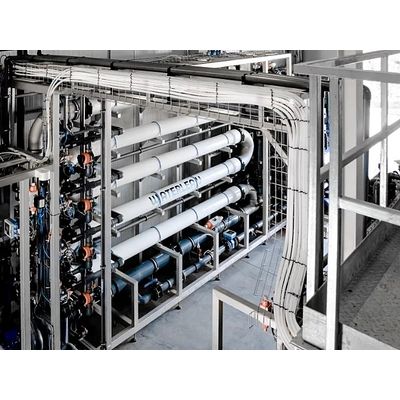
Our AQUALITY®membrane Ultra-filtration and Reverse Osmosis solutions are designed for closing the water loop. Although both use membranes as a barrier, the process of reverse osmosis is not the same as filtration.
Filtration is the removal of particles by size exclusion, while in reverse osmosis such physical holes may not exist. With reverse osmosis, water is able to diffuse through the membrane polymer by bonding between segments of the polymer`s chemical structure
Types of membrane filtration systems
There are four primary types of membrane filtration processes, each serving different purposes based on the size of the particles they filter and the needs of various industries:
Our AQUALITY®membrane Ultra-filtration and Reverse Osmosis solutions are designed for closing the water loop. Although both use membranes as a barrier, the process of reverse osmosis is not the same as filtration.
Filtration is the removal of particles by size exclusion, while in reverse osmosis such physical holes may not exist. With reverse osmosis, water is able to diffuse through the membrane polymer by bonding between segments of the polymer`s chemical structure.
Our AQUALITY® membrane technology produces high-quality water and integrates seamlessly in any existing wastewater treatment or water recovery plant.
- Ultrafiltration (AQUALITY® UF)
- Revrerse Osmosis (AQUALITY® RO)
- High Recovery Reverse Osmosis (AQUALITY® HRRO)
Our AQUALITY® Ultrafiltration (UF) is a variety of membrane filtration in which hydro-static pressure forces a liquid against a semi-permeable membrane. The permeable membrane becomes a barrier to suspended solids and bacteria, producing water with very high purity and low silt density.
Ready for drinkwater and Reverse Osmosis applicationsThe filtrate is typically characterized by a complete removal of suspended solids, a log 5 reduction (>99.999%) of bacteria such as Cryptosporidium, a filtrate turbidity <0.1 NTU (no matter what the feed-water turbidity is) and an SDI (Silt Density Index) < 2.
This means that the filtrate is ready for reuse in drinking water applications or is perfectly pre-conditioned to serve as feedwater for a reverse osmosis installation
- Municipal drinking water production
- Industrial process water make-up
- Feedwater sources for drinking water or process water can be of any kind, such as
- Turbid ground water
- Surface water
- Seawater
- Bio-effluent
The AQUALITY® Reverse Osmosis technology makes use of semi-permeable membranes for the removal of dissolved salts and potential viruses from the feed water after suspended solids, viruses and colloidal material have been removed in a previous filtration step.
While ultra-filtration will retain suspended solids, AQUALITY® RO will retain dissolved solids.
Cross-flow filtration
The AQUALITY®RO desalination process uses a pump and a semi-permeable membrane. The pump provides the driving force for the separation, while the semi-permeable membrane passes water in preference to the solute that is dissolved in the water. The majority of the solute is left behind to form a more concentrated stream. Since feed and concentrate stream move tangentially to the membrane, the filtration principle is called cross-flow filtration.
Applications
- Seawater desalination
- Desalination of brackish water
- Production of highly purified process water
- Production of drinking water from any water source
Used in the following industries
AQUALITY® HRRO is an advanced Reverse Osmosis allowing to boost water recovery from 75 up to 95 percent.
Traditional reverse osmosis is designed in a sequential multi-membrane, multi-stage configuration, each membrane making a small contribution to the overall water recovery. Improved recovery is only achieved in adding RO stages, requiring higher Capex, Opex and footprint.
AQUALITY® HRRO features equal feed and permeate flow rates. At a predefined set point, the system automatically flushes out all the concentrate, returning to its normal operation mode. By increasing the cycles within the same configuration, recovery rates up to 95% can be achieved.
When to use AQUALITY® HRRO?
- As a smart alternative for RO
- In a combination of feed-water + RO concentrate recovery
- As a brine concentrator
- When fluctuating inlet conductivity
- To reduce chemicals consumption in the production of demin water
Applications
- Process water production
- Pure water supply
- Wastewater reuse
- Ingredient water
- Boiler water
- Brackish water desalination
- Drinking water production