


- Home
- Companies
- Goltens Worldwide Management ...
- Services
- Crankshaft Annealing and In-Situ ...
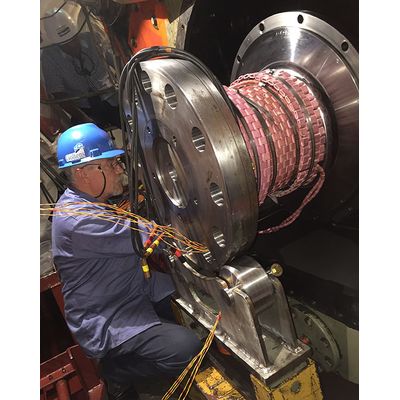
Crankshaft Annealing and In-Situ Annealing
Saving operators millions on repairs and limiting asset downtime around the world. Crankshaft casualties often result in extremely high hardness levels in the crankpin, and that hardness has to be removed or the shaft will have to be condemned and replaced. Goltens has now successfully salvaged hundreds of crankshafts in over 50 countries across industries with its class approved and well proven in-place annealing process.
Historically the only option was to try and machine below the high crankshaft hardness, which very often resulted in a condemned shaft if the hardness extended below the rated diameter. Even if the machining was successful, a large amount of material generally needed to be removed from the shaft, limiting expected lifespan.
With in-situ annealing, the amount of material machined off the crankshaft is generally much less substantial, leaving significantly more material on the journal, which extends the life expectancy of the shaft. Goltens’ process for annealing crankshafts and other shafting can be done successfully In-Situ (with the crankshaft in-place) as well as in our workshops around the world. A deep understanding of the metallurgy, expansion characteristics and safety precautions has been developed and refined over the years into a safe, repeatable, highly controlled process.
At the end of the day, it’s really about two separate but related costs; the cost of the repair path chosen, and the cost of avoidable downtime for the engine. Annealing minimizes both, limiting the out-of-pocket repair expense, and restoring the engine in a matter of weeks as opposed to what can often turn out to be months.
With the annealing repair process so well-proven, pursuing a pure machining repair is akin to throwing away money.
- Germanischer Lloyd Class approved annealing process
- Comprehensive capability to handle all aspects of hardness treatment inclusive of engine preparation, Inspection, pre-machining, hardness removal and finish machining as well as engine reassembly
- A large, global team of highly skilled In-Situ technicians to ensure a rapid, expert response anytime and anywhere
- Deep experience successfully annealing crankshafts across a broad array of makes and models of engines and rotating machinery
- Globally deployed and available portable annealing equipment for In-Situ application
- Bearing Failure / Bearing Meltdown resulting in areas in the journal surface with excessive hardness values
Annealing is a heat treatment process commonly used to remove the stress and hardness within a metal and to increase its ductility. Hardness is a measure of how resistant solid matter is to permanent shape change under application of force, and ductility is a material’s ability to deform under stress.
On a molecular level, when a metal such as steel cools down rapidly, the crystalline grains in the metal transform into a lenticular shape. This causes the metal to become harder but also more brittle in the process. Heating the metal to an appropriate temperature causes a homogenous growth of new crystals. The more heat is applied to the metal, the more its ductility increases and its hardness decreases. During annealing, the steel is heated above its critical temperature and held at this temperature for a period of time before controlled cooling. The controlled cooling process allows the crystals to diffuse into a more flexible, cubic-shaped state.