

- Home
- Companies
- National Alternative Fuels Training ...
- Training
- Alternative Fuel and Electric Vehicle ...
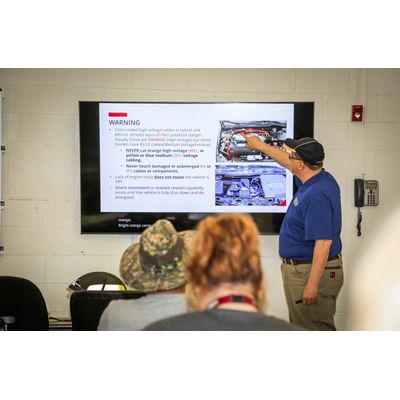
Alternative Fuel and Electric Vehicle First Responder Safety Training
Available for groups only, this training educates first responders on the properties and procedures to follow when dealing with alternative fuel vehicles (AFV), including electric vehicles (EV) and hybrid electric vehicles (HEV). Participants are trained on the differences between AFVs, EVs, HEVs and their conventional counterparts and on the proper procedures for safely addressing incidents involving natural gas, propane autogas, hydrogen, electric drive, ethanol and biofuel powered vehicles. Participants learn the steps required to secure an AFV/EV/HEV, how to rescue occupants from a damaged vehicle, and proper fire response to an alternative fuel or battery fire. The training details the risks and hazards common to AFV/EV/HEV storage, including high-voltage batteries and high pressure gaseous fuel cylinders.
Trainings may be in person or online and may be tailored to meet the client’s needs. For EV training, WVU FSE uses NAFTC’s Hybrid Electric Vehicle Training Educator, a cutaway Toyota Prius™ that allows first responders to actually see the major high-voltage and other internal vehicle components.
After completing this training, participants will be able to:- List the key properties, characteristics, and functions of alternative fuels.
- Explain the operation of AFV/EV/HEVs.
- Recognize AFV/EV/HEV components.
- Identify the risk and hazards common to alternative fuel and battery storage.
- List the steps required to secure an AFV/EV/HEV.
- Follow the steps for rescuing occupants from a damaged AFV/EV/HEV.
- Demonstrate proper response to fires and fuel leaks of AFV/EV/HEVs.