- Home
- Companies
- Salher
- Applications
- Solutions for water treatment in the ...
Solutions for water treatment in the beverage industry - Food and Beverage - Beverage
In the beverage and spirit industry, the discharges show an extreme irregularity in terms of flows, wastewater composition, contaminants concentration and production seasonality.
Water is the basic raw material to produce beverages, thus Salher analyzes the most convenient treatment according to the production volume, manufacturing methods and the outlet parameters required.
These analysis tasks are performed both for the manufacturing process water and for the discharge wastewater.
The production of one liter of wine requires between 30 and 250 liters of water. Wine discharges are not toxic, however, they have an important pollutant effect due to the high organic load.
The wineries discharges can be variable – volume and pollutant concentration – due to the seasonal nature of the production (up to 60% of the spillage occurs during the period of harvesting and transfer of the wine), the volume of production of each winery and the operations carried out such as processing, ageing, storage and bottling.
Liquid-solid separation is required to avoid clogging in pipes, pumps and other water treatment elements.
Salher recommends screening system to separate coarse and fine particles (larger than 1 mm) such as seeds, peels, branches, etc.
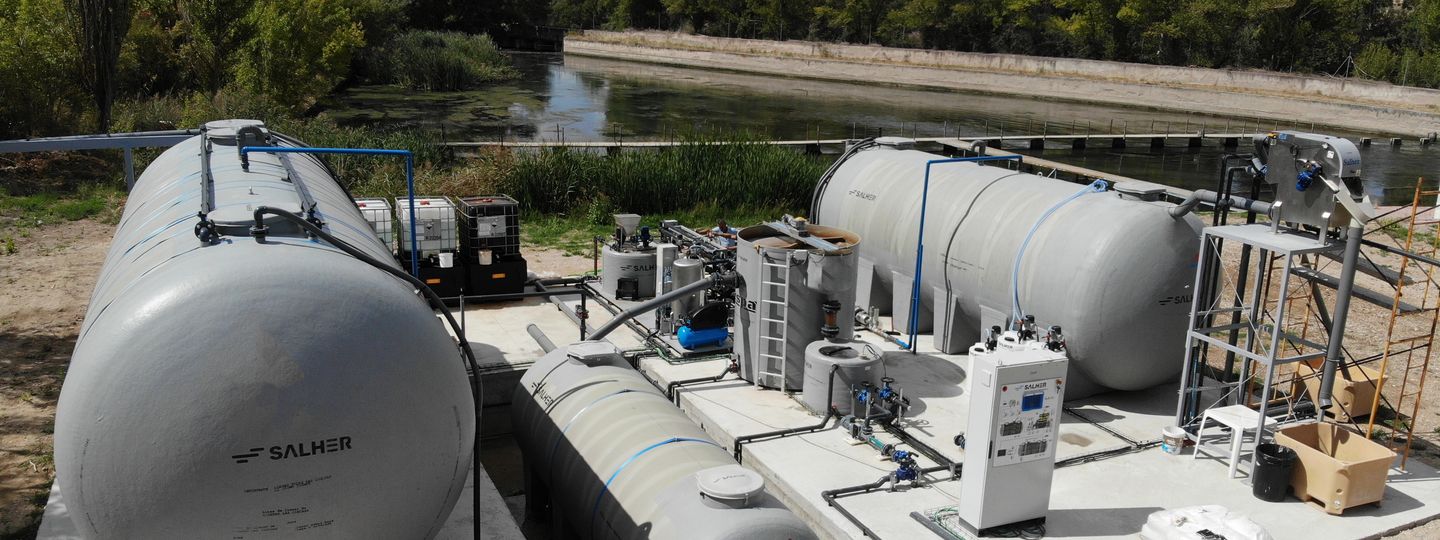
Physical-chemical treatment.For primary treatment, we recommend a DAF (Dissolved Air Flotation) equipment, such as our Vespa, to remove the thinnest solid particles and the floating waste present in the water (oils, greases, …).
Through the injection of chemical products, the physico-chemical treatment facilitates the coagulation and flocculation of suspended particles, and facilitates their flotation for subsequent removal. With this treatment , it is possible to improve the removal yields of suspended solids, oils and grease to more than 95%. This also leads to a reduction of BOD5 equal to or greater than 50%.
The biological treatment aims to remove the organic matter (BOD5), suspended matter (SM), and performs the oxidation of reduced nitrogen (NTK) to nitrate (NO³) => nitrification phase.
Salher offers four different types of secondary treatment:
1. Low load activated sludge treatment
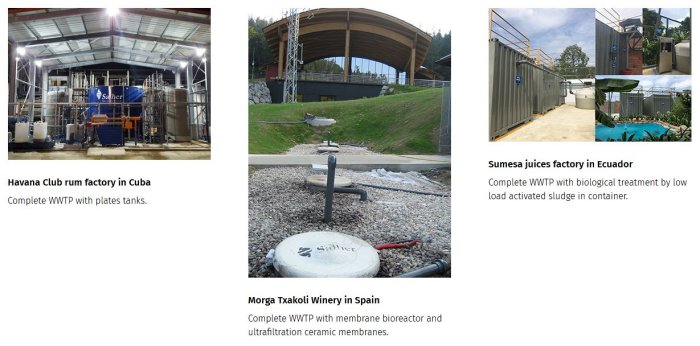
With this treatment, the removal of organic matter and colloidal solids present in wastewater is performed in an aerobic environment through the intervention of microorganisms for its degradation.
For a better productivity, an oxygen supply and distribution system is added in the biological reactor through a fine bubble diffusers grid. These diffusers (60 microns) achieve high performances in the oxygen transfer processes thanks to their small diameter and slow rise up to the surface.
The clarification stage, also called “secondary settling ” aims to separate by density difference the biological solids from water, thus obtaining sludge in the lower part of the reactor and a clarified water at the outlet of the equipment.
2. Moving bed Biofilm Reactor process (MBBR)
This treatment reduces the volume of biological reactors. A settling tank shall be installed for the removal of the sludge contained in the reactor.
3. Membrane bioreactor process (MBR)
The ultrafiltration membranes system replaces the conventional activated sludge treatment and combines filtration, aeration and clarification in a single operation. Its compactness and modularity are also remarkable. Another remarkable element of this system is its compactness and modularity; if necessary to treat larger flows, simply expand the number of cartridges quickly and easily. The main advantages of the MBR treatment, compared to other options are the following:
- Lower volume in the biological reactor.
- Lower production of sludge, approximately 50 – 60%, compared to the low load activated sludge treatment.
- Better outlet water quality.
- Possible water reuse.
- Compliance with the strictest environmental regulations.
4. Biological treatment with ultrafiltration system with ceramic membrane.
This system combines a biological reactor with an external ultrafiltration with inorganic membranes.
To avoid the installation of a wastewater treatment plant with a capacity to treat a volume much larger than the one needed, the following measures shall be implemented:
- Separate industrial from the urban wastewater (water issued from sinks) and rainwater for irrigation because they do not have the same contamination values.
- Perform a prior cleaning of the equipment to eliminate the sub-products (solids and wine lees). Use pressurized water afterwards.
- Raise awareness and train employees regarding water use.