


- Home
- Companies
- Challenger Group
- Products
- Challenger Drumtech - IBC Reprocessing ...
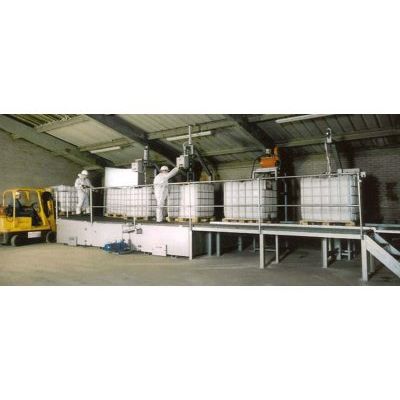
Challenger Drumtech - IBC Reprocessing Lines
The Challenger Drumtech IBC Reprocessing Line is designed to wash, rinse and dry used IBC containers for re - use as a usable package generally as shown in the photograph above and the containers are transferred between stations by hand.
Stage 1:
Soiled IBC`s are loaded by means of a forklift truck onto the in-feed platform where the valve is opened and the cap removed. Here the contents are allowed to drain into a sump beneath
Stage 2:
Where licensed disposal operators contain them for removal. Alternatively, they can be treated on site by the users own separating / treatment plant. The sump is independent from the other tanks and has mud doors to allow flushing out and sludge removal. Stage 2: Located above this sump, is used as an outside jetting area where labels are removed and soiling is washed off using a high pressure washing lance. A splashguard is incorporated at the rear of the platform.
Stage 3:
Uses a re-circulated hot caustic detergent wash inside the container to chemically clean the inside. The Head is positioned using pneumatics into the IBC which seal against overspill and on being given a signal operates the timed wash cycle. The wash tank uses a steam coil for heating the detergent. The tank is complete with pump, filters and mud doors for cleaning. By the virtue of using a chemical pre-wash stage, the load on the power jetting system is reduced by means of removing the bulk of the residues coating the IBC walls and base.
Stage 4:
Consists of a high pressure jetting station for the inside of the container. This drains into a sump below which overflows back to the pre - wash stage 3. So that finally removed deposits naturally balance back toward the containment tank. A motorised cyclic high-pressure head is introduced into the IBC by means of pneumatics, which also seal against splashing. The cyclic operation ensures full coverage of the interior of the container under high-pressure jets. The power unit has the facility to give a hot rinse using fuel oil as a heating medium if desired though normally it is used cold. Detergent can be introduced if desired although this stage is usually a rinse stage. A timer is used to give a controlled process.
Stage 5:
This station is used to remove residues from the pockets either side of the valve area, and any residual water. Vacuum is used to extract the moisture using a hand held lance and during which the IBC is tilted to assist in moisture collection. A mop is often used to soak up droplets at this stage. Many users will accept IBC`s, which have been dried to this condition.
Stage 6:
If the user requires fully dry containers, this station is used to re-circulate hot air inside the IBC. A steam coil heat exchanger with high-powered fan ensures high circulation flow. The flexible duct is introduced into the IBC opening manually.
Stage 7:
It is important to allow the IBC to cool before leak testing is attempted. Here a ramp to floor level gives a buffer zone to allow this cooling.
Stage 8:
The containers are tested for tightness at this station. A head is introduced into the IBC and is clamped in place using pneumatics. Upon being given a signal, the tester automatically follows a timed test procedure, green or red lights indicating pass or fail.