

- Home
- Companies
- Fostoria Process Equipment
- Products
- Fostoria - Medium and Hi-Velocity ...
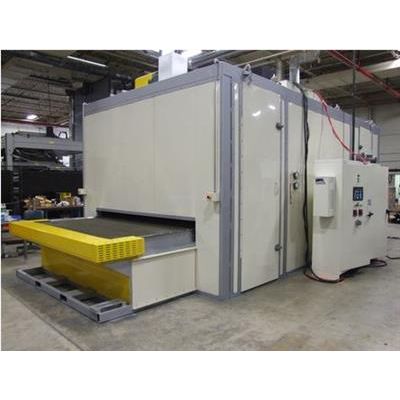
Fostoria - Medium and Hi-Velocity Convection Ovens
All objects are surrounded by a relatively still layer of air which acts as an insulator around the object. This layer of air is known as the boundary layer. When drying a finish on the surface of an object the vapors pass from the finish to the surrounding boundary layer of air which becomes heavily saturated with the vapors.
The principle behind Fostoria high velocity air ovens is to impinge high velocity heated air against the finish to be dried, through a series of slot nozzles at velocities up to 13,500 ft/min. The high velocity air continuously removes the stagnant boundary layer of air surrounding the finish and replaces it with fresh heated air to dry the finish. This reduces the insulating effect of the boundary layer to an absolute minimum and enhances the transfer of heat into the finish. Because the finish is dried faster, the substrate is heated less, reducing the energy required and minimizing a variety of undesirable effects caused by heating the substrate.
In a Fostoria high velocity dryer, heat is added only in quantities enough to pace the curing reaction of the finish. Air temperatures are generally in the 400° to 500°F range resulting in product temperatures in the 200°F range. It should be understood that Fostoria-Transco dryers are not ovens. Temperatures outside the direct path of the nozzle flow are moderate. Thus, the dryers provide drying or curing, but not cooking or baking.
To facilitate the large volumes of air being moved in the dryer, an exhaust plenum and blower are provided to draw the air away after impingement. Frequently, the exhaust air can be ducted to another drying stage for additional energy savings. The exhaust air may also be returned to the heat source and recirculated with only a small percentage being exhausted and most of the heat reclaimed.
For high velocity air drying to be effective, nozzle velocities should exceed 6,000 fpm. Fostoria high velocity dryers are available with velocities up to 13,500 ft/min and our medium velocity dryers are in the 6,000 to 9,000 ft/min range. The key to obtaining these air velocity levels lies with the horsepower of the fan motors as well as the design of the dryer air flow system and slot nozzles. There are some drying applications which may require lower velocities such as thick coatings, coatings with skinning and blistering problems, or specially shaped parts. Whatever the application may be, it is important to match the dryer velocity with the particular drying requirements of the application.
- ENERGY EFFICIENT - Energy is the key element in most industrial processes. Fostoria dryers inherently minimize the energy required to dry a finish. Unlike conventional convection dryers which require heating up an entire chamber, the heat in high velocity dryers is directly impinged onto the finish. This enhances the transfer of heat into the finish and significantly reduces the amount of heat required. The temperature outside the direct path of the nozzle flow is moderate. Also, high velocity dryers utilize only enough heat to pace the curing reaction of the finish.
- ANY ENERGY SOURCE - Fostoria dryers can utilize gas, oil, high and low pressure steam, electric and electric infrared as heat sources. Steam, in some cases, can be provided by waste-fueled boilers
- LESS FLOOR SPACE - High velocity air drying is one of the fastest methods for drying a finish. Fostoria dryers will allow faster line speeds than conventional dryers for the same finish drying requirement. If the line speed is fixed, then a Fostoria dryer will occupy less space (line length) than a conventional dryer for the same finish.
- BETTER QUALITY FINISHES - The high volume, low temperature air drying in Fostoria dryers completely removes solvents from a coating, for a superior finish. The solvents are removed before the coating surface hardens resulting in an extremely durable, blister-free finish. Also, all inlets and recirculated air are filtered prior to being heated and impinged on the surface finish. All of the air in the dryer enclosure then is free from dust and dirt particles to ensure clean, quality finishes.
- LOWER OPERATING COSTS... LOW MAINTENANCE - High velocity air drying has proven to be among the fastest, most efficient methods for removing solvents from a coating. By shortening time cycles and line lengths while reducing the energy required for operation, Fostoria ovens reduce operating costs. Maintenance costs are kept minimal since the dryers are designed to permit easy access and service of component parts.
While each Fostoria oven is individually designed to meet the drying requirements of a particular application, all of the dryers are equipped with certain standard design features which assure their operating efficiency and dependable performance.
The oven enclosure is constructed of heavy duty aluminized steel panels which are insulated with up to 6" of high temperature insulation. This insures that the heated air is confined within the dryer enclosure and directed to the product.
Optimum design slot nozzles impinge the heated air onto the product. The spacing and sizing of these nozzles is dependent on the air velocity requirements of the application. The nozzles are designed to impinge an even, direct path of air flow onto the product to provide thorough, uniform product drying.
Access doors extend the full length of both sides of the dryer to permit easy access to the dryer chamber for maintenance purposes. The access doors on one side of the dryer are hinged in such a way that they serve as explosion relief panels for safety purposes.
A heat recirculation system continuously recycles the heated air after it is impinged onto the product. Only a small percentage of the air is exhausted and most of the heat is reclaimed. The heat recirculation system maximizes energy efficiency.
A complete closed-loop control system to maintain the continuous, efficient operation of the oven is provided. This system operates by monitoring the temperature of the heated inlet air and automatically modulating the temperature of this air to maintain a given set temperature within the oven. Additional controls usually provided with the control system include interlock disconnect switches, purge timer, automatic ignition, overload protection and flame proof. Other special control devices can be incorporated with the oven control system as required.