


- Home
- Companies
- ARS Technologies Inc.
- Products
- Pneumatic Fracturing (PF)
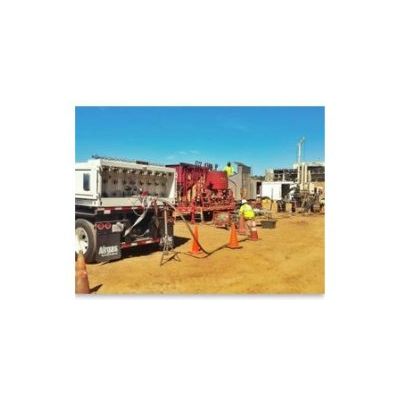
Pneumatic Fracturing (PF)
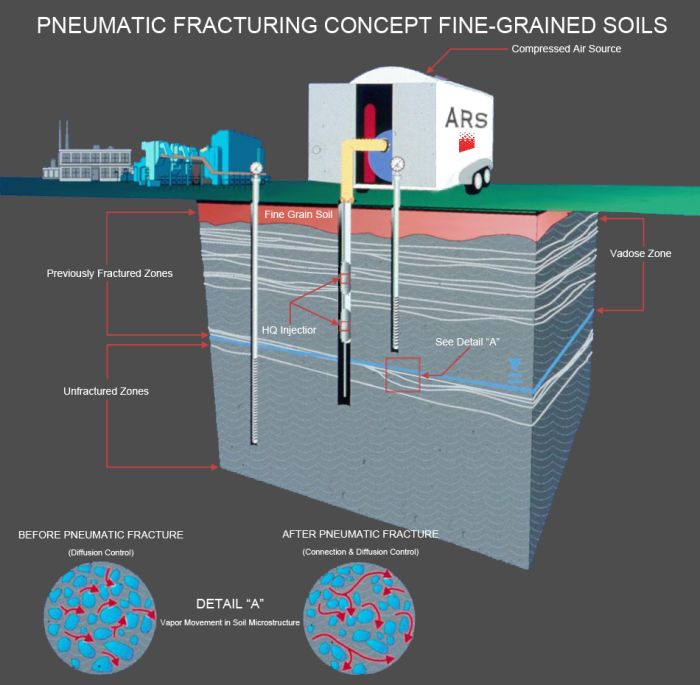
Pneumatic Fracturing (PF) can best be described as a process whereby a gas is injected into the subsurface at pressures exceeding the natural in situ pressures in the soil/rock interface (i.e. overburden pressure, cohesive stresses, etc.) and at flow volumes exceeding the natural permeability of the formation.
The result is the propagation of a dense network of fractures surrounding the injection well taking advantage of existing fractures or planes of weakness within the soil or rock matrices.
In turn, this fracture network enhances the overall effective bulk permeability of the formation, thus allowing the selected in situ treatment approach to work effectively.
Once created, this fracture network has shown to last in excess of five years. The process works equally well above or below the water table.
Depending on depth, fracture propagation distances of 30-60 feet are common in rock formations. Unconsolidated soils such as silts and clays typically exhibit fracture propagation distances of 20-40 feet.
Assessing a Site for Pneumatic Fracturing
It is important to thoroughly evaluate the geotechnical characteristics of the formation during the design phase of a fracturing project. Exploratory borings in the proposed treatment zone with continuous sampling or coring are recommended. The borings are normally supplemented with geotechnical tests performed on collected samples of the geologic material to be fractured.
Historically, the following geotechnical field and laboratory tests are used to evaluate soil and rock formations for fracturing projects:
With over 400 projects completed, ARS has acquired one of the largest databases on low permeability and heterogeneous site geology in the world. Therefore, we will have experience fracturing in your formation or a formation very similar to yours. Thus, we can typically design a pneumatic fracturing protocol after examining representative boring logs from your site.
Soil
- Detailed visual examination to assess structure including stratification, friability, secondary structure, and inclusions
- Grain size analysis
- Evaluation of consistency if cohesive, or relative density if cohesionless
- Natural moisture content
- Plasticity testing, including Atterberg limits
- Location of water table and perched water zones
- In situ permeability testing; e.g., slug, vapor extraction, pumping
Rock
- Detailed visual examination to assess lithology, joint frequency and orientation, degree of weathering, joint filling, and natural bedding
- Computation of recovery ratios
- Rock Quality Designation (RQD)
- Strength testing (in some cases)
- Location of water table and perched water zones
- In situ permeability testing; e.g., slug, vapor extraction, pumping