


- Home
- Companies
- Solinst Canada Ltd.
- Products
- Solinst - Model 401 - Waterloo ...
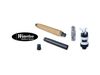
Solinst - Model 401 -Waterloo Multilevel Groundwater Monitoring System
The 401 Waterloo Multilevel System allows detailed groundwater monitoring from many zones in one borehole. The System is modular to allow ports to be located accurately at desired monitoring zones. The zones are permanently isolated by packers or seals and each port is individually connected to the surface. Ports can be fitted with dedicated Transducers, Bladder Pumps and/or Double Valve Pumps. Alternatively, a port may be fitted with a monitoring tube that is left open for use with narrow diameter portable equipment, such as the 102 or Mini 102 Water Level Meter and a narrow diameter Inertial Pump, a Peristaltic Pump or the Micro Double Valve Pump.
Ports, packers and casing lengths are assembled, as needed, into a water-tight PVC or stainless steel casing string. The modular Waterloo System allows complete customization to each application. Systems can be installed on an angle or vertically. A drilling rig is not necessarily required during installation. Monitoring is fast and efficient, especially if dedicated equipment is used.
The Waterloo System is used to obtain groundwater samples, hydraulic head measurements, and permeability measurements from up to 7 discretely isolated zones in a single borehole. They provide 3D data of contaminant flow and concentrations, cost savings through fewer drilled holes, and accurate data for site interpretation and assessment. Systems are customized to meet the needs of each product.
The Waterloo System is used to obtain groundwater samples, hydraulic head measurements and permeability measurements from many discretely isolated zones in a single borehole.
The Waterloo System originated with Dr. John Cherry at the Groundwater Institute of the University of Waterloo in 1984. Ongoing development of the System by Solinst has taken place on a continuous basis since then, with encouragement and suggestions from Dr. Cherry.
When a number of Waterloo Systems are used at a site, they allow detailed three-dimensional groundwater information to be obtained at a reasonable cost. Fewer drilled holes are an advantage and monitoring times are reduced.
The simple modular system is customized for the needs of each project. This allows monitoring zones to be placed at desired depths using options suitable for either bedrock, overburden or combination applications and with either permanent or removable systems.
Discrete zone monitoring is the only means of obtaining accurate data for site interpretation and assessments. Transects of multilevels provide the detailed data necessary to calculate mass flux and conservatively assess risk to receptors.
Advantages of the Waterloo System
- Detailed depth of flow and concentrations
- Reduced project costs
- Purging and sampling times reduced
- Fewer drilled holes
- Reduced site disturbance
- Variety of monitoring options
- Isolate sampling at discrete contaminant zones
- High-resolution site characterization
Multi-Port Installations
- Overburden or Bedrock Installations
- Allow monitoring of multiple zones in any geologic setting
- Groundwater or vadose zone installations
- Permanent Waterloo Packers
- Designed for bedrock or cased holes
- Engineered for permanent seals
Why Multilevels: Provide a Clearer Understanding of Subsurface Conditions
Superior quality of data is captured when monitoring a series of discrete isolated intervals at various depths in a single borehole. The detailed information provided by Multilevels Groundwater Monitoring Systems in the form of horizontal and vertical flow, in conjunction with discrete zone sampling for contaminants, is necessary for accurate site assessments.
- Improve Site Assessments and Risk Management
- Multilevels provide high resolution data for input into more representative conceptual site models.
- Transects of Multilevels across a groundwater flow path provide the best data to use for Mass Flux calculations. This has proven to be an important tool for site assessments that require realistic estimates of maximum contaminant concentration/risk to receptors.
- Optimize performance of in-situ remediation by using detailed 3-D data from a series of Multilevels. Subsequently, transects can be used to evaluate the success of the chosen remediation option and any improvements.
- The Economics Make Sense
- Proven cost reductions for drilling and sediment disposal.
- Field personnel time and disposal costs are low, when purge volumes are reduced. The discrete interval that a Multilevel port encompasses allows for smaller purge volumes, rapid responses to level changes and is ideal for low flow sampling techniques.
- Overcome Biases with Long Screened Wells
- Contaminant mixing over long screens masks vertical variations resulting in underestimating the aerial extent of plumes and diluting the true concentration of contaminants.
- Ambient vertical flow within the well has potential to transmit contaminants to non-contaminated zones.
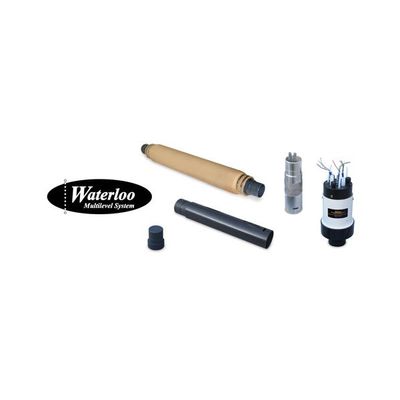
The Waterloo System uses modular components which form a sealed casing string of various casing lengths, packers, ports, a base plug and a surface manifold. This allows accurate placement of ports at precise monitoring zones.
Monitoring tubes attached to the stem of each port individually connect that monitoring zone to the surface. The standard system is built on 2" (50 mm) Sch. 80 PVC to fit 3"- 4" (75 - 100 mm) boreholes and uses 3 ft. (915 mm) long packers. Stainless steel components and PTFE tubing are available.
Modular Sealing Joints*
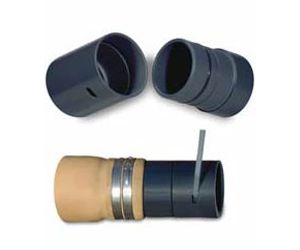
The slip-on joint design of the Waterloo System uses a nylon shear wire and an o-ring. This gives reliable, leakproof joints so that the core of the Waterloo casing string is isolated from external formation waters. Groundwater is only accessible via the port stems and attached monitoring equipment. This water-tight seal also prevents contact between packer inflation water inside the casing and the formation water outside the casing.
Customized Wellhead Manifolds
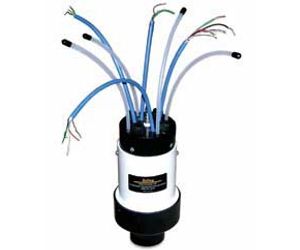
The manifold completes the system at surface. It organizes, identifies, and coordinates the tubes and/or cables from each monitoring zone.
The manifold allows connection to each dedicated transducer in turn, and a simple, one-step connection for operation of pumps. When dedicated pumps are selected, a unique wellhead allows individual zones to be purged separately, or purging of many zones simultaneously to reduce field times.
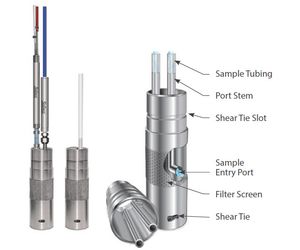
Waterloo System monitoring ports are constructed from 316 stainless steel. Ports are isolated by packers at each desired monitoring zone and are individually connected to the surface manifold with narrow diameter tubing. Thus formation water enters the port, passes into the stem, up into the monitoring tube attached to the stem, to its static level.
A sampling pump or pressure transducer may be dedicated to each monitoring zone by attachment to the port stem. Dual stem ports are available to allow both sampling and hydraulic head measurements from the same port. Alternatively, the monitoring tubes may be left open to allow sampling and hydraulic head measurements with portable equipment.
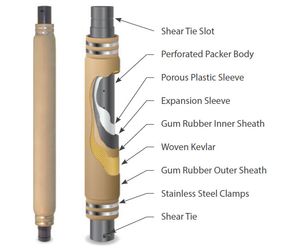
Permanent packers ensure long term integrity of seals in cored bedrock holes and cased wells. They use a water activated expansion sleeve fitted over the perforated packer body. A layer of porous plastic distributes water evenly to the packer expansion material. A Rubber/Kevlar/Rubber sheath envelops the expansion material. The Kevlar layer provides strength to bridge across large fissures. The pliant gum rubber forms an effective seal against the borehole wall.
Water is added to the inside of the sealed casing string after installation. The water passes through the packer body into the expansion sleeve, causing the material to expand. Thus an engineered seal is permanently formed against the borehole wall.
Dedicated sampling pumps and/or pressure transducers – Each monitoring port may be fitted with a dedicated sampling pump and/or pressure transducer. This maximizes the speed with which each data set can be obtained, and eliminates the need to decontaminate and repeatedly lower portable devices. The sampling pumps are suitable for sampling many types of contaminants, including VOCs (Volatile Organic Compounds). Purge volumes are very small. With dedicated pumps all zones can be purged simultaneously. Ports with two stems allows a dedicated pump and a transducer to be placed at exactly the same level.
Open tubes – The most basic version uses open tubes attached to each port. This option allows monitoring with a portable sampler and a narrow diameter Water Level Meter. This provides a very economical and flexible multilevel monitoring device.
Mix of open tubes and dedicated equipment – A third option is to choose a mix of open tubes and dedicated equipment in different zones. This method combines the advantages of less expensive portable equipment for shallower zones and the more time efficient dedicated equipment for deeper zones.
Water level monitoring only – The Waterloo Multilevel System can comprise pressure transducers only, for pressure monitoring in up to 24 discrete zones.