

LAMBDA Gesellschaft für Gastechnik mbH products
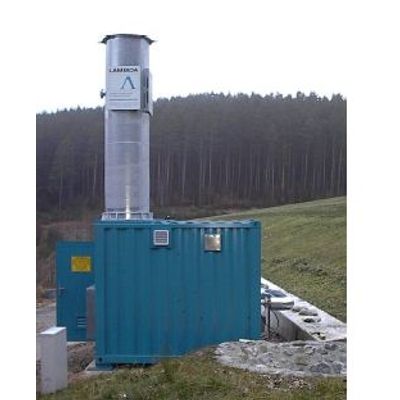
Compact Plants
Gas feed, high-temperature flare and control system are integrated in one container in LAMBDA compact plants. This means smaller dimensions and flexible applications. Both pressure-controlled rotary compressors and blowers are used to feed the landfill gas. The landfill gas is treated in a high-temperature flare which is temperature-controlled to observe the specifications of the Technical Instructions on Air Quality. The compact plants generally include a gas manifold to connect up to 8 gas wells, a condensation separator with gas filter as well as all the safety elements such as flame arresters, rapid-action stop valves or flare flame monitoring. A condensation collection tank or an utilisation outlet for a cogeneration unit can also be provided on request.
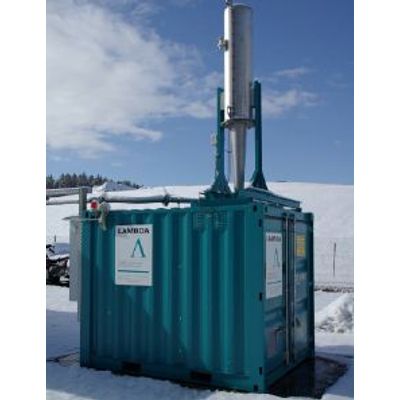
LAMBDA-CHC (Poor-gas-system)
Small, economical gas extraction stations that can be used with a high degree of flexibility with various utilisation and treatment technologies are required for active gas extraction from older landfills. LAMBDA has a compact and cost-effective gas extraction station precisely for this application. Apart from the LAMBDA CHC, freestanding conventional HT flares or biological treatment methods such as e.g. LAMBDA-OCHC can be connected. Pressurecontrolled operation is provided to permit the connection of small gas engines. External collecting pipes can also be provided to connect several landfill gas sections to the container. The station has a condensation separator as standard with a demister block and integrated fine gas filter. A condensation collector (e.g. 750 litre capacity) in the container can be connected to the condensation separator optionally. The machine room and gas analysis have room air monitoring. The station extraction amount is recorded by a turbine gas meter.
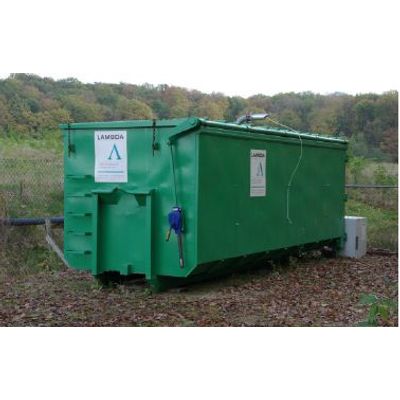
LAMBDA-OCHC (Biological Filter)
Biological methane oxidation represents one solution to treating landfill gas with methane contents below 20 %. In this process, the methane available is converted into CO2 and H2O by methanotrophic bacteria under the presence of oxygen. The reaction results in a gain in energy which is used by the bacteria for metabolic activities and to form new cells. The landfill gas is introduced into the lower section of the filter undiluted and the amount of air required is distributed over three air supply levels with different flow rates in this innovative OCHC biofilter system. Thus every point in the filter has only the amount of oxygen required for the biological methane oxidation. The retention time is therefore optimised and the flow rate of inert gases (particularly nitrogen) is minimised.
LAMBDA-NCHC
The NCHC process is suitable for all waste waters with high nitrogen concentrations and low BSB5 content such as e.g.: landfill leachates, highly polluted component currents from sewage plants or process water from the treatment of biological waste. This innovative NCHC process is based on the biological conversion of ammonium and nitrite into atmospheric nitrogen, a process that only takes place in the absence of oxygen. This so-called anaerobic ammonium oxidation takes place in solid-phase activated carbon inoculated with correspondingly specialised strains of bacteria. Partial oxidation of ammonium in the course of shortened nitrification is required (nitritation) in an upstream step since the waste water to be treated usually contains no or only very little nitrite. The use of the NCHC process thus permits extensive elimination of ammonium nitrogen with complete omission of the denitrification required in conventional process concepts. This means external carbon sources can be dispensed with to a great extent and, as a direct consequence, there is a clear reduction in excess sludge production. Combined with the lower energy requirement (decreased oxygenation capacity), this then results in a great decrease in operating costs for the plant operator.Gas Feed Unit
The LAMBDA gas feed unit represents plant technology with multi-functional applications. It can be used both in mines to suction off large amounts of gas and to transport biogas over long distances to the next utilisation point. The plant technology is designed individually for the respective requirements. The unit has a condensation separator with demister block and an integrated gas fine filter as standard. A condensation collection unit (e.g. 1,000 litre capacity) can be connected to the separator as an option. The machine room and gas analysis have an air monitoring system. A gas meter (turbine meter or mass flow meter) registers the station flow. The selection of proven and profitable individual components means the plant has a high level of operational reliability with excellent profitability. The combination of speed regulation, rotary regulator and mechanical pressure regulator means the plant has a wide operating range both with regard to the feed amount and regarding the suction and pressure ranges that can be achieved. The gas analysis unit can also be supplied optionally with a CO2-analyser in addition to the standard channels CH4 and O2. Data telecommunication and remote evaluation can also be provided in the switching cabinet. Several compressor units can be operated in combination using the extensive programming of the Siemens control system. Up to four units can implement gas feed amounts of up to 16,000 m³/h as standard under a master container.