


- Home
- Companies
- Entech Instruments, Inc.
- Products
- Entech - Model Flash-VASE - Thermal ...
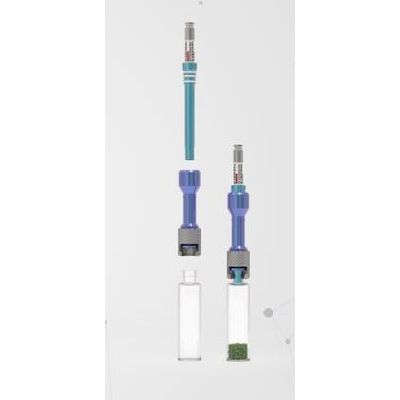
Entech - Model Flash-VASE -Thermal Extraction Technique For Matrices w/Low Volatility
Flash-VASE is a next generation Thermal Extraction technique that places the sample in very close proximity to the collection sorbent, and uses static extraction under vacuum to more efficiently and completely recover volatile through semi-volatile compounds. Flash-VASE places the sample within a few centimeters of the collection sorbent, with no flowing gases to heat up the sorbent during the extraction which is a known problem with dynamic headspace techniques, so the collected compounds stay optimally close to the front of the sorbent bed for fast and complete release to the GC. Extraction under a vacuum allows recovery of chemicals at a lower temperature, reducing or avoiding breakdown of the matrix itself. Flash-VASE has a tremendous number of advantages over other thermal extraction techniques, allowing Chemists to truly “See What’s Really There™”, in a way that keeps the analytical system clean and free from carryover.
Flash-VASE is intended for samples containing relatively low moisture and solvent levels, as the sample is heated anywhere from 30 °C to 330 °C while in a closed system, so the potential for generating a substantial amount of vapor during Thermal Extractions should be considered. However, small amounts of water can be Flashed onto the Sorbent Pen with removal afterwards either by cooling the vial on a cold tray to pull water back down out of the Pens, or by placing a vacuum on the Pens to pull the water off prior to thermal desorption into a GCM.
Flash-VASE provides incredibly reproducible results, by eliminating the inconsistencies inherent in dynamically purged Thermal Extractions. Below is an example of 8 replicate Cannabis analyses for Monoterpene and Sesquiterpene profiling, and these 8 runs almost perfectly overlap. The Flash-VASE extraction times in these examples was just 5 minutes, at 100 °C. Higher temperatures will yield reproducible recovery of the Cannabinoids present in Cannabis.
The Vacuum X-traction Bar (VXB) supports sample extraction onto Sorbent Pens and the cleanup of associated extraction hardware (sleeves, O-rings, etc). The VXB allows extractions to be performed in the sample preparation area, with only the extracts on Sorbent Pens brought into the GCMS laboratory. This is similar to how sample preparation techniques are currently performed, except the Entech vacuum extraction methods are easier, cleaner, and more sensitive, all without the use of hazardous solvents. The VXB comes in 30” and 50” sizes, allowing for convenient above the bench management of the Flash-VASE Modules. Other modules may also be connected, such as the 3700 Thermal Vacuum Cleaning System, which is utilized to restore background-free extraction hardware before performing the next set of extractions.
Many systems attempt to perform thermal extraction by placing a sample into a tube and then directly thermally desorbing it into a GC. However, there are several draw-backs associated with this approach:
Samples may not transfer quickly from the sample to a GC column since chemicals of interest will not release very fast from many matrices, causing poor peak shape unless a secondary trapping or focusing system is used
Therefore, direct desorption methods often have to heat samples hotter to reduce band broadening, but higher temperatures will increase thermal degradation of the target compounds and the matrix
Liberated compounds must remain in contact with the matrix longer during a pre-heating step, rather than allowing their removal once they become mobile
Chemicals must diffuse out of the matrix at positive GC carrier gas pressures which slows down outgassing rates relative to a vacuum thermal extraction approach
Samples with a high volatiles content can backflash into the GC carrier gas delivery lines, permanently contaminating the lines until the entire injection system is removed and solvent rinsed.
Many matrices simply cannot be heated to GC injection temperatures, even momentarily, without changing them chemically, potentially creating artifact chemicals that were not in the original sample
There is no water/moisture management opportunities when directly desorbing a sample into a GCMS
Loading a sample into a 1/4” glass tube before direct desorption is more difficult than loading it into a vial, and some sample may drop into the desorber or injector, creating a background until removed
Flash-VASE solves all of these problems by performing an offline vacuum thermal extraction, followed by a moisture removal step if necessary using either a cold plate or applied vacuum once the Pen is removed from the sample vial. This not only improves the performance of thermal extraction solutions, Flash-VASE may be the only way to perform thermal extraction on many thermally labile matrices.
Other thermal extraction systems use small chambers or micro chambers which attempt to thermally extract samples by heating them, flowing a gas over them, and delivering the desorb gas through an outlet port/fitting and into a classical sorbent tube. There are numerous problems associated with this approach as well:
- The cell or chamber can become contaminated when exposed to higher concentration samples
- Difficulty in removing contamination in tubing/fittings between the chamber and the TD Tube
- Loss of high volatility compounds that breakthrough the sorbent in this “open” system
- Loss of low volatility compounds that adsorb to surfaces prior to reaching the TD tube
- Heating of the front of the sorbent bed can occur when trying to maintain a hot transfer system all the way to the collection sorbent. Hot gas introduced onto a sorbent will allow compounds to penetrate further into the sorbent, resulting in lower thermal desorption recoveries and greater potential for carryover
- Channeling Effects are exhibited while flowing through a sorbent trap, causing reduced recovery, increased carryover, and increased thermal degradation by requiring higher desorption temperatures during analysis
Flash-VASE eliminates these concerns as well. A glass vial is the entire “sample chamber”, which is used once and discarded, so no chance of carryover. There are no transfer lines and connective fittings in the flow path, as the opening of the Sorbent Pen is right at the top of the vial. There is no hot carrier gas to heat up the sorbent, so the penetration of compounds into the sorbent is far less, making their recovery during thermal desorption more complete and at lower desorption temperatures. The Flash-VASE closed system means that even very light compounds will be recovered, as long as they have more affinity for the sorbent in the Pen than they do for the heated sample matrix. Finally, the extraction occurs diffusively, eliminating channeling and all of the negative effects this has on recovery, carryover, and sampler lifetimes.